
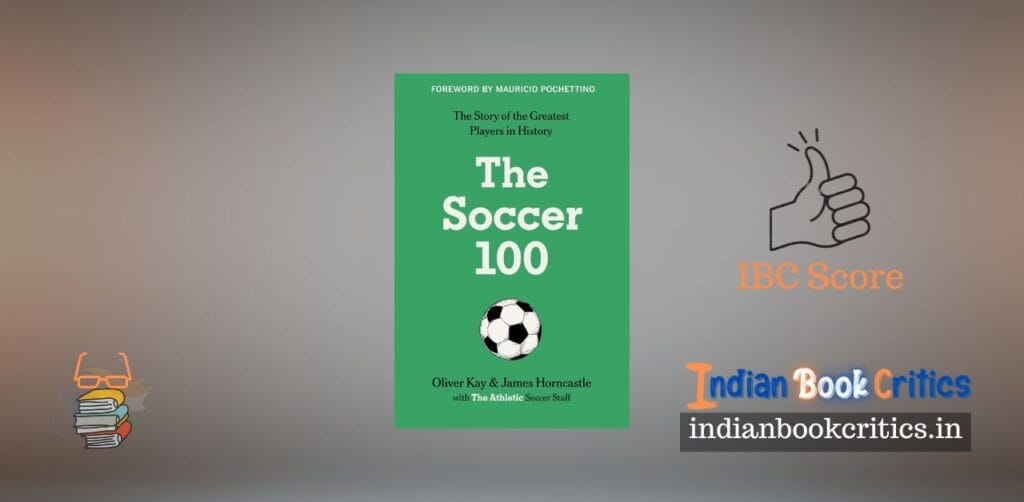
Some books demand to be read from the first page to the last. Others invite readers to wander through them, pausing wherever curiosity leads. The Soccer 100 belongs to a rarer category. It may initially appear to be another ranking of football’s greatest players. Yet, the deeper one ventures into its pages, the more apparent it becomes that the rankings merely provide an architectural framework. The true substance of the book lies elsewhere. It lies in the stories, the memories, the personalities, the cultural contexts and, above all, the extraordinary ability of football to transform ordinary human beings into enduring myths.
Produced by Oliver Kay, James Horncastle and the accomplished team of writers from The Athletic, this volume is an ambitious attempt to narrate the history of football through one hundred extraordinary careers. The undertaking itself borders on the impossible. Every generation believes its heroes are incomparable. Every nation claims ownership of football’s greatest legends. Every supporter carries an emotional hierarchy that statistics can neither validate nor dismantle. The editors understand this impossibility from the outset. Oliver Kay candidly acknowledges the difficulty of comparing footballers across vastly different eras, writing that “Comparing players in different positions, across different eras, is fraught with difficulty.” Later, he admits with refreshing honesty that “Data was not our friend here.”
This admission immediately distinguishes The Soccer 100 from countless books that attempt to manufacture objectivity through numerical analysis. Football has never been a sport that submits entirely to mathematics. Numbers explain goals, assists, appearances and trophies. They seldom explain why millions still remember Garrincha’s impossible dribbles, why Diego Maradona’s performance against England in 1986 continues to inspire scholarly essays, or why Johan Cruyff altered football long after he had stopped playing. Football, perhaps more than any other sport, thrives upon memory, imagination and emotion. The editors wisely recognise this limitation.
Mauricio Pochettino’s foreword establishes this emotional landscape beautifully. Rather than immediately discussing rankings, he begins with childhood memories from Murphy in Argentina, where football was less a sport than an inseparable part of daily existence. His observation that “Before you learn to run, you start to touch the ball with your feet” encapsulates the organic relationship between South American culture and football. Later, reflecting upon the incomparable artistry of Lionel Messi and Diego Maradona, he produces one of the most memorable metaphors in the book: “The ball never looked happier than when it was at the feet of Maradona or Messi.”
This is not analytical language. It is poetic language. It demonstrates that even elite football professionals often resort to metaphor when attempting to describe transcendent genius. Technical vocabulary proves insufficient before extraordinary talent.
Pochettino’s reflections further reinforce an important idea that permeates the entire volume. Greatness cannot be reduced to technical excellence alone. According to him, football’s greatest players possess a unique energy, a charisma that alters the emotional atmosphere of a match. Speaking of Messi and Maradona, he observes that “When they are on the ball, the energy changes.” This simple sentence perhaps explains why football supporters remain fascinated by legendary players decades after retirement. Great players do not merely participate in matches. They redefine them.
Oliver Kay continues this philosophical approach in his introduction. He recalls discovering a tattered football book during childhood and describes how those names, many completely unfamiliar at the time, opened an entirely new world. The recollection is deeply personal, but it also reflects the experience of countless football enthusiasts whose understanding of the sport gradually expanded beyond local clubs and contemporary stars.
The editors repeatedly remind readers that this project is fundamentally about storytelling rather than definitive judgment. Kay explicitly states, “That is the thing. This book is about the stories. The rankings? Not so much, we hope.” Few editorial decisions reveal greater wisdom than this.
Indeed, the book succeeds because it refuses to become imprisoned by its own numerical framework.
Had the authors concentrated solely upon defending every ranking, the book would have deteriorated into an endless exercise in justification. Instead, each player’s placement merely introduces a carefully crafted essay exploring an individual career, a defining match, a cultural legacy or a forgotten historical moment. The numerical sequence becomes almost incidental. Readers frequently find themselves forgetting whether they are reading about the ninety-ninth or the nineteenth-greatest player because the essays possess intrinsic literary value.
One of the book’s greatest achievements is the remarkable diversity of its narrative techniques. The contributors do not simply summarise careers chronologically. They constantly experiment with perspective. Some chapters reconstruct iconic matches almost minute by minute. Others investigate the political circumstances surrounding players’ careers. Several examine tactical revolutions, while others resemble biographical sketches enriched by interviews and archival research.
Oliver Kay outlines this editorial philosophy with admirable clarity when introducing the contributors’ approaches. Jack Lang explores Garrincha through his unforgettable dribbling; Phil Hay reconstructs Johan Cruyff’s genius through the defender humiliated by the famous Cruyff Turn; Michael Cox analyses Maradona’s brilliance through a single match; Daniel Taylor travels to Madeira in pursuit of Cristiano Ronaldo’s origins; Adam Crafton recalls his encounter with Zlatan Ibrahimović. Such variety prevents monotony across more than seven hundred pages. Each essay develops its own personality while remaining faithful to the larger project.
The collaborative nature of the book deserves particular appreciation. Multi-author compilations often suffer from uneven quality, stylistic inconsistency and repetitive observations. Surprisingly, The Soccer 100 avoids most of these pitfalls. Individual voices remain distinct, yet careful editorial supervision ensures coherence throughout. The transitions from one player to another feel natural because every writer understands the overarching objective: to illuminate greatness rather than merely catalogue achievements.
The treatment of Uwe Seeler illustrates this philosophy magnificently. Instead of beginning with goals, trophies or statistics, Seb Stafford-Bloor opens in contemporary Hamburg. The essay gradually transforms into a meditation upon loyalty, civic identity and regional memory. Seeler emerges not simply as a prolific striker but as an embodiment of Hamburg itself. The description of supporters honouring him with the banner, “Uns Uwe, loyal und bescheiden, der Größte aller Zeiten,” captures an emotional truth that statistics alone could never convey. The accompanying explanation of the local dialect transforms a football biography into a subtle cultural history.
Equally impressive is the recurring willingness of the authors to acknowledge uncertainty. The editorial team openly describes their voting process, confessing that they repeatedly exclaimed, “How is he below him?” and “How is he not in the top 100?” after compiling the initial rankings. Such transparency enhances the credibility of the project. Rather than pretending to possess unquestionable authority, the editors invite readers into the deliberative process itself. The ranking becomes an informed conversation rather than an immutable decree.
Perhaps the finest quality of The Soccer 100 lies in its refusal to reduce football to entertainment alone. Throughout the volume, football appears as social history, cultural identity, political expression and artistic performance simultaneously. Players are presented not merely as athletes but as products of their societies, representatives of their cities and, occasionally, symbols that transcend sport altogether. This multidimensional approach elevates the book beyond conventional football literature.
By the conclusion of its introductory chapters, one realises that The Soccer 100 is not asking readers to agree with every ranking. It asks something considerably more meaningful. It asks readers to remember why football has occupied such an extraordinary place in human imagination for more than a century. The answer lies neither in league tables nor in trophy cabinets. It resides in stories that continue to inspire long after the final whistle has faded into history.
That, above all else, is the enduring promise with which this remarkable volume begins.
If you love the game of Football, you will probably love reading this book that brings the history of football and footballers across generations to the lovers of the game. From the 20th century to the 2022 World Cup, from George Best to Luka Modrić, from Ronaldo (R9) to Cristiano Ronaldo, from Pele to Zinedine Zidane, from Maradona, the charismatic controller, to Messi, the undoubtedly miraculous, the ultimate best, the Greatest of All Time – this book, with its smooth and captivating writing, brings alive the footballers on the pages.
Click here to get a copy from Amazon – buy now.
Review by Amit Mishra for Indian Book Critics
The Soccer 100: More Than a Ranking, A Celebration of Football's Immortal Stories
-
IBC Critical Rating
Summary
If you want to know about footballers, the best ones, across generations, this is a must-read book!