
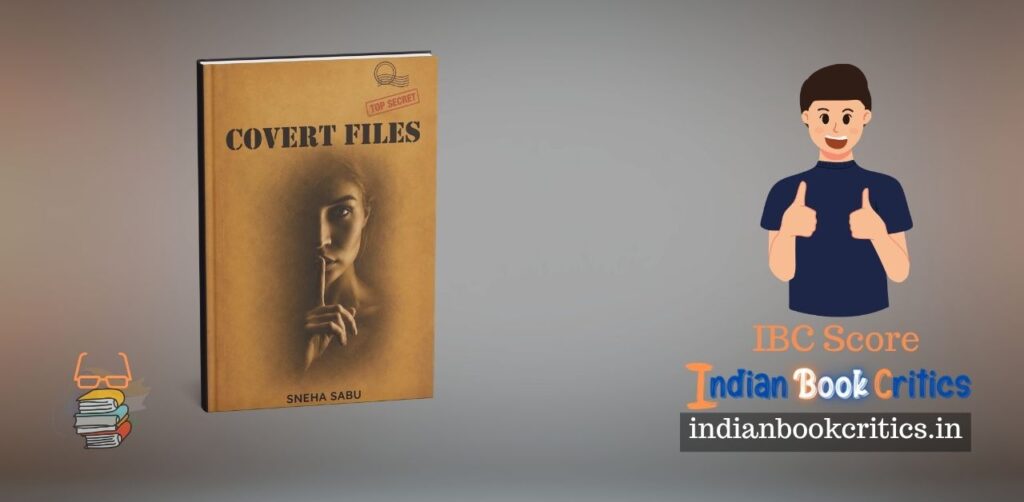
If you remember what you read, and do it ardently, in contemporary Indian English literature, comic prose has frequently struggled to escape the shadows of social satire, polite domestic irony, or anglicised elite banter. From the domestic observances of R. K. Narayan to the modern middle-class satirical vignettes of Upamanyu Chatterjee and Cyrus Broacha, Indian comedic writing has historically negotiated the tension between respectable decorum and subversively absurd realism. Sneha Sabu’s short story collection, Covert Files, introduces a bold, somatic, and uninhibited voice into this literary tradition. Authored by an international strategist and development thinker whose prior creative endeavours earned twenty-one international awards, the book shifts focus from external socio-political commentary to the intimate, unpredictable, and mortifying realities of the human body. Through five distinct episodes, Sabu constructs a narrative framework centred on the protagonist Samara, affectionately called Sam, and her personified plus-size bum, Shanthanu. By elevating corporeal awkwardness and physiological mishaps to the status of high literary comedy, Covert Files executes a fascinating subversion of bourgeois propriety and modern lifestyle anxieties.
The foundational brilliance of Covert Files resides in its audacious narrative structure, specifically the creation of a dialogic, internal relationship between Samara and Shanthanu. Rather than treating the physical body as a passive vessel or an unmentionable background entity, Sabu personifies Samara’s posterior as a distinct, vocal conversational partner possessing its own agency, temperament, anxieties, and philosophical outlook. This stylistic choice invokes Mikhail Bakhtin’s theory of the carnivalesque, wherein the lower bodily stratum is liberated from institutional silence and restored to a central role in human expression. Shanthanu acts simultaneously as Samara’s pragmatic critic, co-conspirator, and somatic conscience, frequently interjecting with comedic observations during moments of physical distress.
This personification achieves something crucial within modern Indian women’s writing. Historically, female corporeality in Indian English fiction has often been subjected to moral surveillance, aesthetic idealisation, or tragic domestic endurance. Sabu dismantles these idealisations by foregrounding body positivity, physical vulnerability, and unvarnished bodily functions. When Samara asserts in the final story that she loves herself in all sizes and shapes, the statement carries genuine weight because it arrives after pages of shared somatic struggle rather than superficial platitudes. The humour is never mean-spirited; instead, it celebrates the absurd resilience of the human organism navigating a world designed for rigid physical standardisation.
An examination of individual chapters demonstrates how Sabu utilises narrative pacing, spatial irony, and dialogue to transform mundane embarrassments into compelling literary narrative.
The opening chapter, “Commando Operations,” sets the comedic tone by juxtaposing mundane urban routine with sudden physical betrayal. Set against a cold winter backdrop where Samara uses a portable heater to warm Shanthanu, the narrative transitions rapidly to a bustling shopping plaza. Wearing a floral dress and loose black knickers, Samara purchases Vietnamese rice paper rolls and sits down to eat. The narrative tension escalates as the elastic band of her underwear breaks, causing the garment to slide down her legs in the middle of a crowded food court. Sabu captures the internal panic and physical coordination required to navigate public embarrassment when Samara kicks the fallen underwear beneath a public garbage bin:
“The black knickers slid down Sam’s legs and to the floor. Sam, you are a commando! Shanthanu, we need to kick the knickers under the bin before more people see them on the floor.”
This scene captures the fragile facade of modern social elegance. The contrast between Samara’s glamorous pink floral dress and the immediate necessity of sprinting home like an Olympic athlete highlights how swiftly daily propriety can dissolve into raw survival instinct.
In the second story, “The Theory of Susu,” Sabu shifts from wardrobe mishaps to physical exhaustion and acute bodily pain. What begins as an optimistic Easter weekend road trip to the Blue Mountains for a 6.3 kilometre bushwalk through the Grand Canyon quickly turns into an ordeal of severe muscle incapacitation. Navigating steep forest stairs in pitch darkness with only a phone torch, Samara suffers debilitating muscle cramps in both thighs. The true comedic climax occurs the following morning, when Samara finds herself entirely unable to bend her knees to sit on the toilet. Shanthanu intervenes by devising an ingenious geometrical solution:
“When a man pees, the pee falls at an acute angle when he stands. You mean at 45 degrees, Shanthanu? More or less… Turn towards the flush tank and keep your legs on either side of the seat… Now stand and pee! Though it is a right-angle pee, it will fall into the water hole since you are standing near the flush tank.”
Here, Sabu converts an excruciatingly painful physical reality into a moment of practical innovation. By naming this novel stance “The Theory of Susu,” the text elevates everyday bodily problem-solving into a formal, humorous philosophy.
The third narrative, “7700 Emergency Landing,” provides a biting critique of modern transit and budget air travel. En route to a cousin’s wedding in India via Kuala Lumpur, Samara finds herself squeezed into seat 36C of a low-cost carrier, where metal armrests jam tightly against Shanthanu. The claustrophobic ordeal escalates into slapstick chaos when flight attendants attempt to physically pull Samara free, only for mid-flight turbulence to cause a clumsy multi-person tumble onto the cabin floor. The disaster follows her to her budget hotel in Malaysia, where a wobbly ceramic toilet cracks under weight and collapses completely. The chapter concludes with Samara being transported to the hospital in an ambulance to receive seven stitches, highlighting the vulnerability of the human body when subjected to fragile infrastructure and cramped commercial spaces.
In “The Break-In: Double Trap,” Sabu skilfully parodies the tropes of the crime thriller and gothic mystery. Set during a stormy monsoon night at a remote rubber plantation house in Kerala, an axe-wielding intruder breaks in through an air conditioning duct to steal a confidential witness protection file. Suspense dissolves into comedy when Samara accidentally sits on a tube of carpenter’s glue left on her bed, binding her pyjamas permanently to the bedsheet. Simultaneously, the thief tries to crawl backwards through the metallic air conditioner vent, getting his own posterior firmly wedged in the frame. The resultant double trap forces Samara, her pyjamas torn from behind, to administer first aid to the bleeding burglar before handing him over to the police, subverting traditional violent confrontation into a moment of shared human absurdity.
The final chapter, “Morse Code: The Universal Communication,” delivers the collection’s most explicit philosophical proposition regarding corporeal universality. After consuming spicy cheese and jalapeño fritters in Bondi, Samara suffers an acute digestive disruption and seeks refuge in a hidden mezzanine washroom within her corporate office building. As flatulence and diarrhoea ensue, she hears neighbouring colleagues in adjacent stalls undergoing identical digestive distress. Sabu equates these involuntary intestinal sounds to a universal linguistic system:
“Shanthanu, do you know Morse code?… It is a universal communication code… Shanthanu, I find breaking wind universal. A form of communication that our intestines and body resort to in response to what we eat. In a discriminatory world, I like the universal nature of communication that this system offers.”
By comparing toilet stall noises to an impromptu musical concert and an egalitarian Morse code, Sabu transforms a universally taboo topic into a unifying human equaliser that dissolves corporate hierarchies and social pretences.
While Covert Files succeeds admirably as a vibrant work of humour, a reader-critic must acknowledge certain structural and stylistic limitations within the text. Primary among these is the narrative’s heavy reliance on episodic escalation and repetitive situational formulas. Across all five chapters, the plot trajectory follows a predictable pattern: an ordinary activity begins, a sudden physical malfunction occurs, the situation escalates to hyper-exaggerated proportions, and a chaotic resolution ensues. While this formula maximises comedic impact for casual reading, it creates narrative predictability when read sequentially as a full volume.
Furthermore, Sabu’s dedication to simple rhetoric flattens secondary characterisation. Figures such as flight attendants, hotel staff, neighbours, and police officers function primarily as static comedic props or reactionary sounding boards rather than fully realised literary figures. Finally, the intentional exaggeration of real-life incidents sometimes crosses into pure slapstick, which may diminish the intellectual resonance of the author’s underlying commentary on modern bodily taboos.
Despite these minor limitations, Covert Files possesses substantial worth and literary relevance within the modern cultural landscape. In an era dominated by curated social media personas, relentless physical perfectionism, and acute anxiety over public image, Sabu’s unpretentious celebration of physical imperfection operates as a therapeutic antidote. The book refuses to mask the messy, unpredictable, and absurd realities of living in a physical body. By presenting these covert experiences through lighthearted rhetoric and relatable narrative situations, Sabu achieves her stated goal of offering readers a witty, refreshing escape from daily stress. Ultimately, Covert Files stands out as a pioneering, bold, and delightfully authentic addition to contemporary Indian English light literature, reminding readers that laughter at our shared vulnerabilities remains the ultimate human universal.
You may get a copy from Amazon India – click here to buy now.
Review by Parakashtha for Indian Book Critics
Covert Files by Sneha Sabu – Review
-
IBC Critical Rating
Summary
A fresh narrative that challenges the conventional decorum of contemporary Indian English fiction… and I do recommend it!