
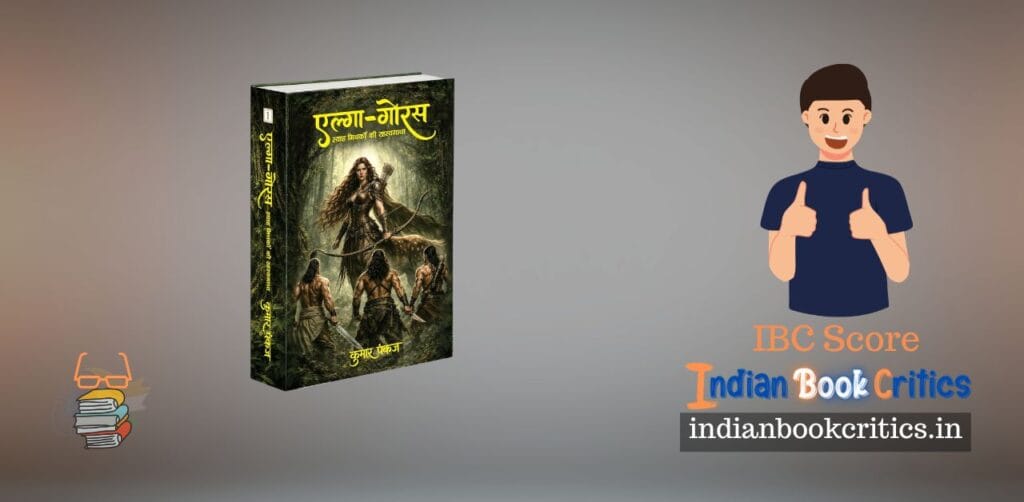
There are certain books that merely entertain, certain books that impress with technical brilliance, and then there are rare books that attempt to create an entirely new imaginative universe for readers to inhabit. Elga Gorus by Kumar Pankaj belongs firmly to the third category. In contemporary Hindi literature, where realism, social commentary, and autobiographical narratives often dominate the literary landscape, fantasy and tilism-based storytelling have remained surprisingly neglected. The legacy of Devaki Nandan Khatri and his immortal Chandrakanta still looms large over Hindi fantasy literature, as very few writers since him have attempted to build a similarly vast and mysterious fictional universe. Kumar Pankaj’s Elga Gorus emerges in this context as an ambitious and refreshing literary intervention. It is not merely a fantasy novel but an elaborate mythic structure built with mystery, imagination, symbolism, adventure, and philosophical undertones. The novel revives the spirit of tilism and dark mythology while simultaneously giving it a modern literary texture. Reading Elga Gorus often feels like entering a forgotten civilisation hidden beneath centuries of silence and shadows.
One of the most remarkable achievements of the novel is its astonishing world-building. Kumar Pankaj does not construct a superficial fantasy realm populated merely by strange creatures and dramatic battles. Instead, he creates an entire ecosystem of myths, rituals, mysterious histories, hidden powers, forgotten scripts, ancient books, and uncanny landscapes. The novel introduces readers to a world inhabited by dwarfs, gigantic beings, mystical entities, strange warriors, and shadowy forces operating beneath visible reality. The mysterious sacred text called Elga Gorus, engraved upon thousands of square wax tablets, becomes the symbolic centre of the narrative. The mythology surrounding this text gives the novel an almost sacred aura. The reader constantly senses that every object, every creature, and every event carries layers of hidden meaning. This atmosphere of secrecy and gradual revelation is one of the novel’s greatest strengths. Kumar Pankaj understands that mystery is not merely created through concealment but through suggestion. He carefully allows fragments of information to emerge slowly, ensuring that curiosity remains alive throughout the reading experience.
The novel revolves around a fascinating journey involving an old fakir and three young men who embark upon a dangerous quest filled with strange territories, mysterious settlements, deadly confrontations, and terrifying discoveries. Their search for the sacred book Elga Gorus becomes much more than a physical adventure. It transforms into a spiritual and psychological journey through fear, uncertainty, sacrifice, and courage. The landscapes through which these characters travel are vividly imagined. Dense forests, haunted deserts, secret caves, ancient ruins, and settlements inhabited by bizarre creatures create a cinematic atmosphere that continuously expands the imaginative scale of the novel. Kumar Pankaj possesses a rare visual imagination. Several scenes unfold with such clarity and intensity that they appear almost filmic in nature. One can easily imagine the novel adapted into a large-scale visual epic because of the richness of its imagery and the dramatic power of its settings.
The characters in Elga Gorus deserve special appreciation because they elevate the novel beyond mere fantasy spectacle. Many fantasy novels fail because their characters exist only as functional devices to move the plot forward. Kumar Pankaj avoids this weakness by giving even unusual or fantastical figures emotional presence and psychological individuality. The novel features a large cast spread across two volumes, and, admittedly, keeping track of every individual and every thread of the expanding narrative can initially feel daunting. However, the compelling nature of the storytelling ensures that readers remain emotionally connected and oriented within the narrative. Every important character carries a distinct personality, behavioural pattern, and emotional energy. Even secondary figures often leave a strong impression because of the author’s ability to create vivid character identities through gestures, dialogues, symbolic descriptions, and psychological nuances. The strange beings and mythical entities in the novel never feel decorative or artificial. They possess histories, motivations, fears, and mysteries that make them strangely believable within the framework of the fictional world.
Another significant strength of the novel lies in Kumar Pankaj’s language. It is evident throughout the book that the author has an extraordinary command of words and imagery. He experiments fearlessly with vocabulary and introduces hundreds of fresh expressions and newly coined words into the narrative. Yet these linguistic innovations never appear forced or ornamental. Instead, they contribute to the uniqueness of the fictional world. The prose frequently acquires a poetic rhythm, especially during descriptive passages involving mysterious landscapes, supernatural events, or philosophical reflections. The metaphors and similes employed in the novel are strikingly original. Many comparisons feel unfamiliar in the best possible sense because they emerge organically from the imaginative universe the author has constructed. Kumar Pankaj’s language constantly oscillates between lyrical beauty and narrative urgency. This balance prevents the novel from becoming excessively dense while still allowing it literary sophistication.
The element of tilism in Elga Gorus deserves particular attention because it reconnects modern Hindi readers with a storytelling tradition that has gradually faded from mainstream literary production. After Chandrakanta, Hindi literature witnessed surprisingly few large-scale attempts to revive mystery-driven fantasy rooted in indigenous imagination. Kumar Pankaj’s work feels significant because it does not imitate Western fantasy structures blindly. Instead, the novel draws energy from Indian mythic sensibilities, oral storytelling traditions, symbolic archetypes, and mystical imagination. There is darkness in the narrative, but it is not empty darkness designed merely for shock value. It carries spiritual, philosophical, and symbolic dimensions. The mysterious beings, hidden conspiracies, ancient scripts, and cryptic prophecies collectively generate a mythological density that distinguishes the novel from conventional thrillers or fantasy adventures.
What also makes Elga Gorus memorable is its emotional and philosophical undercurrent. Beneath the mysterious events and adventurous quests lies a meditation upon human fear, power, mortality, memory, and transformation. The novel repeatedly suggests that hidden knowledge possesses both destructive and liberating potential. The sacred book itself becomes symbolic of dangerous wisdom guarded by ancient forces. The characters are not simply fighting external enemies but also confronting internal anxieties and existential uncertainties. This philosophical dimension adds intellectual weight to the narrative. Readers looking only for surface-level thrills may still enjoy the novel because of its fast-moving adventure structure, but attentive readers will discover deeper symbolic layers embedded within the storytelling.
The physical presentation of the book also deserves recognition. In recent years, discussions around literature often focus exclusively upon content while ignoring the aesthetic experience of the book as an object. Elga Gorus breaks this pattern through its impressive visual presentation, typography, cover design, and production quality. The book carries the appearance of a collectable artefact rather than an ordinary publication. This visual grandeur complements the mythic scale of the story itself. One can clearly sense the dedication of both the author and the publisher in creating a literary object that visually reflects the richness of its fictional universe. Such careful attention to aesthetic presentation is still relatively rare in Hindi publishing and therefore deserves appreciation.
Of course, the novel’s scale and complexity may occasionally challenge readers unfamiliar with expansive fantasy narratives. The abundance of characters, hidden histories, symbolic references, and parallel developments requires concentration and patience. However, this complexity is also one of the novel’s greatest rewards. Elga Gorus demands immersive reading rather than casual consumption. It invites readers to surrender themselves fully to its world. Once that surrender occurs, the novel becomes extraordinarily absorbing. The narrative momentum remains consistently strong, and the unfolding mysteries compel readers to continue despite the vastness of the fictional universe.
Ultimately, Elga Gorus represents a bold and imaginative achievement in contemporary Hindi literature. Kumar Pankaj demonstrates remarkable creative courage by attempting something so expansive, unconventional, and visually rich in a literary environment where such experimentation remains uncommon. The novel successfully revives the spirit of mystery and tilism associated with classic Hindi fantasy while simultaneously introducing fresh mythologies, modern narrative energy, and philosophical depth. It is a work shaped by imagination, literary ambition, and storytelling confidence. More importantly, it reminds readers that Hindi literature still possesses enormous untapped potential for speculative and mythic storytelling.
In many ways, Elga Gorus feels less like a conventional novel and more like the opening of an entirely new literary universe. Kumar Pankaj has not simply written a fantasy tale; he has constructed a mythological landscape populated by unforgettable characters, hidden truths, terrifying creatures, and symbolic mysteries. The novel deserves appreciation not only for its entertainment value but also for its contribution to the evolution of modern Hindi fantasy literature. Readers who admire mystery, mythology, tilism, philosophical fantasy, and imaginative storytelling will find Elga Gorus deeply rewarding. It is a rare literary experience that combines spectacle with substance and mystery with emotional depth. Few contemporary Hindi novels dare to dream on such a grand scale, and even fewer succeed with such conviction.
You can get this novel in two volumes from Amazon India – click here to buy now.
Review by Adarsh for Indian Book Critics
Elga Gorus by Kumar Pankaj – Review of Hindi Novel
-
IBC Critical Rating
Summary
A must-read Hindi novel that keeps readers involved in a make-believe world of creatures, myths, mysteries and surprises.