
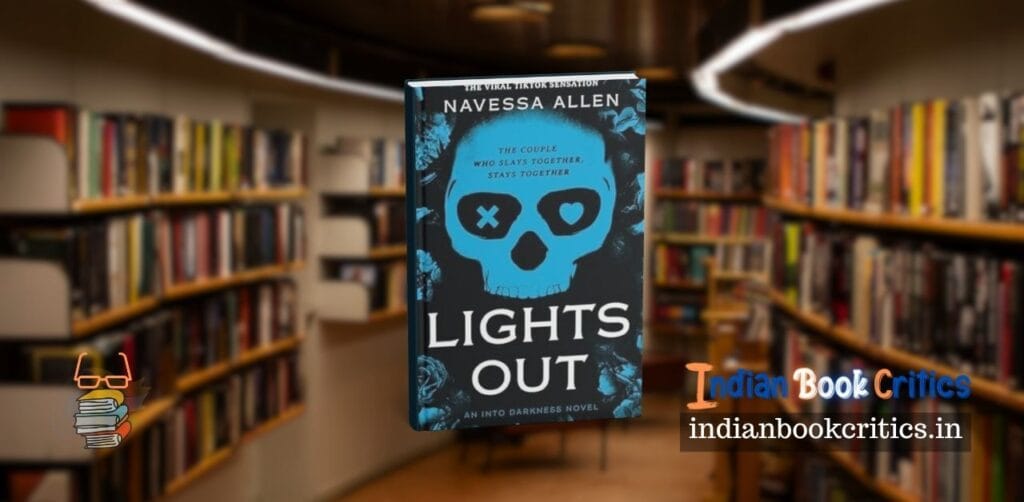
I have been reading literature of various kinds. I have come across novels that sharply use horror and shock as a theme. However, I admire the ones more which better understand how to transform shock into narrative momentum. Lights Out belongs to the latter category, though not without important qualifications. Marketed as a dark stalker romance with strong comedic undertones, the novel arrives carrying an intimidating list of trigger warnings that immediately signal its intention to challenge conventional ideas of romance, morality, and intimacy. Such books often collapse under the weight of their own sensationalism, mistaking transgression for originality. Navessa Allen, however, demonstrates that she possesses considerably more narrative control than many contemporary writers in the dark romance genre. While Lights Out is undoubtedly provocative, its greatest strength lies not in its explicit content but in its understanding of human vulnerability, loneliness, and obsession.
The novel opens with Aly, an emergency room nurse whose exhausting professional life has left her emotionally depleted yet psychologically resilient. Allen deserves considerable appreciation for creating a protagonist whose occupation is not merely decorative but deeply integrated into her personality. Aly’s experiences in the trauma ward expose her to humanity at its absolute worst, and these encounters subtly shape her emotional responses throughout the novel. She is practical without becoming cold, compassionate without appearing naïve, and independent without reducing herself to the increasingly common stereotype of the infallible female protagonist. She feels authentic because she is allowed moments of fatigue, uncertainty, embarrassment and emotional contradiction.
Josh, the male protagonist, is significantly more difficult to evaluate. On paper, he embodies nearly every characteristic that should render him irredeemable. His obsession crosses legal and ethical boundaries with alarming regularity. Privacy becomes almost meaningless in his world. Yet Allen constructs him with sufficient psychological complexity that readers understand, though may never fully condone, his behaviour. This distinction is perhaps the novel’s greatest achievement. Understanding a morally compromised character is not equivalent to endorsing him, and Allen carefully maintains this separation for most of the narrative. Josh is neither romanticised into a misunderstood hero nor reduced to a simplistic villain. Instead, he exists in the uncomfortable territory between attraction and danger, forcing readers to examine why fiction can safely explore desires that reality must firmly reject.
Perhaps the novel’s most surprising accomplishment is its humour. Dark romance frequently suffers from excessive self-seriousness, where every chapter attempts to outdo the previous one in psychological intensity. Lights Out repeatedly interrupts its own darkness with witty dialogue, awkward situations and genuinely entertaining exchanges that humanise its characters. The humour prevents the novel from becoming emotionally exhausting. More importantly, it allows relationships to develop through conversation rather than merely through physical attraction. This balance between tension and levity keeps the narrative surprisingly readable despite its disturbing premise.
Allen’s prose is another notable strength. She avoids unnecessary ornamentation, preferring direct, energetic sentences that maintain momentum. The pacing rarely stagnates because scenes are constructed with a clear sense of purpose. Dialogue flows naturally, internal monologues reveal character rather than merely filling space, and descriptive passages seldom delay the story. This accessibility explains much of the novel’s enormous popularity. Readers are never required to struggle through overwrought language to reach the emotional core of a scene. Instead, Allen allows the situations themselves to generate intensity.
The chemistry between Aly and Josh forms the emotional engine of the novel. Their interactions are unpredictable precisely because both characters possess sufficient individuality. Aly refuses to become a passive participant in Josh’s obsession, while Josh’s emotional awkwardness frequently undermines the image of absolute control he attempts to project. Their relationship evolves through negotiation, confrontation and mutual discovery rather than simple dominance and submission. This complexity elevates the novel above many entries within the genre, where power dynamics often remain frustratingly one-dimensional.
Yet the novel is far from flawless. Its central premise demands an enormous suspension of disbelief, particularly regarding the speed with which certain emotional transitions occur. Readers willing to accept the exaggerated conventions of dark romance may not object, but those seeking psychological realism will undoubtedly find several developments difficult to reconcile with genuine human behaviour. Some pivotal moments rely more upon emotional convenience than believable character progression.
Similarly, the novel occasionally struggles with the ethical implications of its own fantasy. Allen clearly understands that she is writing fiction designed to explore taboo desires rather than provide relationship guidance. Nevertheless, the repeated framing of invasive behaviour through romantic tension occasionally blurs important moral boundaries. Mature readers familiar with the conventions of fantasy and fiction will likely recognise this distinction immediately. Less experienced readers, however, may occasionally find themselves uncomfortable with how swiftly certain violations become incorporated into the emotional framework of the romance. The novel, therefore, requires a level of critical distance from its audience that not every reader may naturally maintain.
The explicit sexual content deserves discussion because it occupies a central position within both the marketing and the narrative. Unlike many commercially successful romances where intimacy simply functions as repetitive spectacle, Allen generally uses these scenes to reveal emotional evolution, trust, insecurity and changing power dynamics. They are certainly graphic, unapologetically so, but they rarely appear entirely disconnected from character development. That said, the sheer frequency of these scenes occasionally slows narrative progression. There are moments when emotional conversations could have strengthened the relationship more effectively than additional physical encounters.
Another limitation lies in the secondary cast. Several supporting characters display considerable charm and serve useful narrative purposes, yet many remain underdeveloped. The world surrounding Aly and Josh occasionally feels narrower than it should. Given Aly’s demanding hospital environment and Josh’s complicated personal circumstances, there existed opportunities to construct richer interpersonal networks that would have expanded the emotional stakes beyond the central romance. However, the novelist could seldom fully utilise those opportunities.
The novel also illustrates a broader issue within contemporary dark romance publishing. Increasingly, publishers and online communities reward escalation. Every successful novel must appear darker, riskier or more controversial than its predecessors. A casual Google Chrome researcher and a highly accomplished Reddit researcher – both may observe the pattern. Allen occasionally appears conscious of these commercial expectations, introducing situations whose primary purpose seems to be to reinforce the novel’s reputation for extremity rather than to deepen its thematic concerns. Fortunately, these moments remain relatively infrequent, but they nevertheless remind readers that market expectations can influence artistic decisions.
From a literary perspective, Lights Out is less interested in realism than in emotional fantasy. It examines obsession, loneliness, performance, vulnerability and desire through heightened circumstances that deliberately exceed ordinary experience. Readers expecting nuanced psychological fiction in the tradition of literary novels may dismiss its exaggerated scenarios. However, evaluating the novel solely by literary realism would misunderstand its objectives. Like Gothic fiction before it, dark romance intentionally magnifies emotional states into dramatic narratives that explore forbidden impulses within the relative safety of fiction.
Navessa Allen also deserves recognition for understanding narrative rhythm. Many romance novels become predictable once the central couple acknowledge their mutual attraction. Lights Out maintains interest because emotional uncertainty persists even after physical intimacy develops. The conflicts increasingly concern trust, identity and emotional exposure rather than simple romantic misunderstanding. This structural choice sustains momentum through the latter half of the novel and prevents it from dissolving into repetitive romantic fulfilment.
Ultimately, Lights Out succeeds because it possesses self-awareness. Allen understands precisely the kind of story she wishes to tell and rarely apologises for it. She neither disguises dark fantasy as healthy realism nor pretends that morally questionable behaviour becomes acceptable simply because attractive people perform it. Instead, she invites readers into an intentionally exaggerated fictional space where dangerous fantasies can be examined without confusing them with prescriptions for real life.
This is not a universally recommended novel. Readers uncomfortable with explicit content, morally ambiguous protagonists, or transgressive romantic dynamics should avoid it entirely, and the trigger warnings deserve to be taken seriously rather than treated as marketing decoration. Yet dismissing the novel merely because of its controversial premise would overlook its genuine craftsmanship. Beneath its provocative exterior lies a well-paced, sharply written, psychologically engaging romance that demonstrates considerably greater intelligence than many of its competitors.
Lights Out is not an important literary novel, nor does it aspire to become one. It is, however, an exceptionally effective example of contemporary commercial dark romance, elevated by memorable characters, confident prose, humour that genuinely lands, and an author who understands the delicate balance between fantasy and emotional authenticity. It pushes boundaries with purpose more often than for mere spectacle, even if it occasionally oversteps in its pursuit of intensity. Whether one ultimately loves or dislikes the novel will depend less upon its quality than upon one’s willingness to engage with the unsettling emotional territory it deliberately inhabits.
Pratibha for Indian Book Critics
Lights Out by Navessa Allen: Book Review
-
IBC Rating