
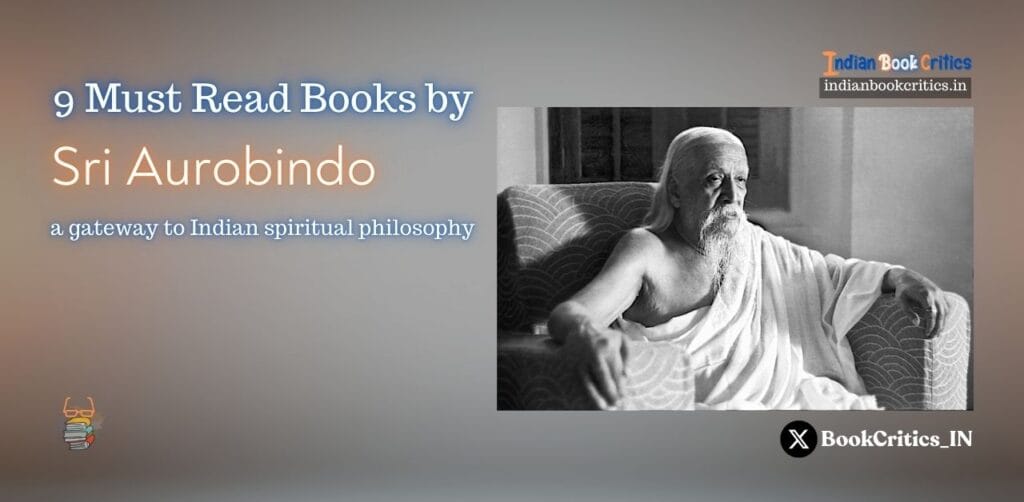
Among the many spiritual thinkers produced by India, Sri Aurobindo occupies a rare position. For many reasons, he stands at the meeting point of ancient Indian wisdom and modern intellectual inquiry. Many readers encounter Indian spirituality through figures such as Swami Vivekananda, Paramahansa Yogananda, or Jiddu Krishnamurti. Each of them contributed something distinctive to the global understanding of Indian philosophy. Vivekananda introduced Vedanta to the modern world with extraordinary clarity. Yogananda brought devotional spirituality and yogic practice to Western audiences. Krishnamurti questioned authority and emphasised direct psychological freedom. And there were many others, and some are continuing, such as Sadhguru, who brought something new to the global grasp of the Indian spiritual philosophy.
Sri Aurobindo, however, attempted something far more ambitious. He tried to reinterpret the entire spiritual tradition of India for the modern age. Though a daunting task to undertake and not completed, for obvious reasons, his attempts were pragmatic and justified. His work explores the Vedanta, the Bhagavad Gita, the Upanishads, and the inner psychology of yoga, yet he does not treat them as relics of the past. Instead, he sees them as evolving systems of knowledge capable of guiding humanity toward a higher consciousness.
What makes Sri Aurobindo fascinating is that he was not only a spiritual teacher but also a poet, philosopher, revolutionary, and scholar. His early life was deeply involved in India’s struggle against colonial rule. However, he realised that mere physical independence from the colonisers might not be sufficient for the purposes he wanted India to pursue. Therefore, later, he withdrew to Pondicherry and devoted himself to spiritual practice and writing. The result is a body of work that moves easily between philosophy, psychology, metaphysics, poetry, and practical spiritual guidance.
For readers who want to understand the depth of Indian spiritual philosophy without relying solely on simplified modern interpretations, Sri Aurobindo offers a remarkably complete vision. His books are not always easy, but they reward patient reading with insights that feel both ancient and surprisingly contemporary.
Below are nine essential books that provide a meaningful entry into his thought.
1. The Life Divine
Often considered Sri Aurobindo’s philosophical masterpiece, The Life Divine attempts to answer one of the oldest questions in human thought. Why does consciousness exist in a universe that appears largely material? Aurobindo proposes that evolution is not merely biological but also spiritual. According to his vision, consciousness gradually unfolds through matter, life, mind, and eventually a higher spiritual awareness he calls the supramental consciousness. The book moves through complex metaphysical arguments yet always returns to a simple idea. Human beings are not the final stage of evolution. They are a transitional form capable of spiritual transformation. Read this book and learn about Sri Aurobindo’s ambitious hopes for humanity!
2. The Synthesis of Yoga
In this book, Aurobindo attempts to unite the major paths of Indian yoga into a coherent spiritual practice. Traditional Indian philosophy often distinguishes between paths such as knowledge, devotion, and action. Aurobindo believed that these approaches should not remain separate. Instead, they could be integrated into what he called Integral Yoga. The text explains how spiritual development can involve intellect, emotion, and practical life simultaneously. Rather than withdrawing completely from the world, Aurobindo suggests that spiritual growth can occur within ordinary human activity.
3. Essays on the Gita
Sri Aurobindo’s interpretation of the Bhagavad Gita stands apart from many traditional commentaries. Instead of focusing only on renunciation or devotion, he reads the text as a profound dialogue about action and spiritual consciousness. The central figure of Arjuna represents the moral struggle of every human being confronted with responsibility and conflict. Aurobindo argues that the Gita teaches a form of spiritual action in which individuals perform their duties while remaining inwardly aligned with a higher consciousness. The essays reveal how ancient scripture can speak directly to modern ethical dilemmas.
4. The Human Cycle
This remarkable book examines the psychological and cultural evolution of human societies. Aurobindo proposes that civilisations move through stages of development that reflect changes in collective consciousness. Early societies emphasised symbolic and religious structures. Later stages emphasise rationality, individual freedom, and social organisation. Yet Aurobindo believes that humanity is now approaching a new stage that integrates spiritual awareness with social progress. The book reads almost like a philosophical history of human culture while suggesting that spiritual consciousness will eventually reshape civilisation itself.
5. The Ideal of Human Unity
Written during a period of intense global political change, this book explores the possibility of international unity. Aurobindo examines the history of empires, nations, and political alliances before asking whether humanity can eventually move toward a more cooperative world order. His analysis is both philosophical and practical. He recognises the powerful forces of nationalism and cultural identity, yet he also believes that human consciousness gradually moves toward broader forms of unity. The book feels surprisingly relevant today as readers reflect on global cooperation and conflict.
6. Savitri
Savitri is perhaps the most unusual and ambitious work in Sri Aurobindo’s entire body of writing. It is an epic poem of enormous length that retells a brief legend from the Mahabharata while transforming it into a vast spiritual allegory. The poem follows Savitri’s journey as she confronts death in order to reclaim the life of her beloved Satyavan. Through this narrative, Aurobindo explores themes of cosmic consciousness, spiritual transformation, and the destiny of humanity. Readers often describe the poem as both philosophical and mystical, offering layers of meaning that reveal themselves slowly. An unimaginable blend of verse and philosophy – must be on every poetry lover’s TBR list!
7. The Foundations of Indian Culture
This collection of essays examines the philosophical and artistic traditions of India with remarkable depth. Aurobindo responds to critics who believed Indian culture was irrational or stagnant. Instead, he demonstrates that Indian philosophy developed sophisticated systems of psychology, metaphysics, and aesthetics long before modern academic disciplines emerged. The essays discuss literature, religion, and social organisation while emphasising the inner spiritual orientation that shaped Indian civilisation. Readers interested in cultural history will find this book particularly illuminating.
8. Letters on Yoga
Unlike Aurobindo’s more formal philosophical works, Letters on Yoga presents his ideas in a conversational and practical format. The book gathers hundreds of letters written to spiritual seekers who asked him questions about meditation, consciousness, and personal transformation. Because these responses address specific problems, they offer unusually clear explanations of his spiritual psychology. Readers often find this book easier to approach than his more abstract philosophical works. It reveals Aurobindo as a teacher responding patiently to the everyday struggles of those pursuing spiritual practice.
9. The Secret of the Veda
In this book, Aurobindo reinterprets the ancient Vedic hymns in a radically different way. Many modern scholars once believed these hymns were simply primitive religious poetry devoted to natural forces. Aurobindo argues that they contain symbolic descriptions of inner spiritual experiences. According to his interpretation, the Vedic gods represent psychological and cosmic principles connected with the evolution of consciousness. Whether readers fully accept his interpretation or not, the book opens a fascinating new perspective on one of the oldest sacred texts in human history.
Concluding Reflections
Reading Sri Aurobindo requires patience and curiosity. His books rarely offer quick spiritual formulas. Instead, they invite readers into a long conversation about consciousness, evolution, and the future of humanity. What makes his work particularly valuable today is the way it bridges ancient wisdom and modern intellectual inquiry.
For readers exploring Indian spiritual literature, Sri Aurobindo offers something remarkably comprehensive. Vivekananda inspires through powerful lectures. Yogananda moves readers through devotion and personal spiritual experience. Krishnamurti challenges psychological conditioning. Sri Aurobindo attempts to integrate all these dimensions within a vast philosophical vision.
If one wishes to understand how Indian spiritual thought can speak to modern life without losing its depth, Sri Aurobindo remains one of the most rewarding authors to read. His work reminds us that spirituality is not only about personal peace. It is also about the long evolution of consciousness itself.
Guddu for Indian Book Critics