
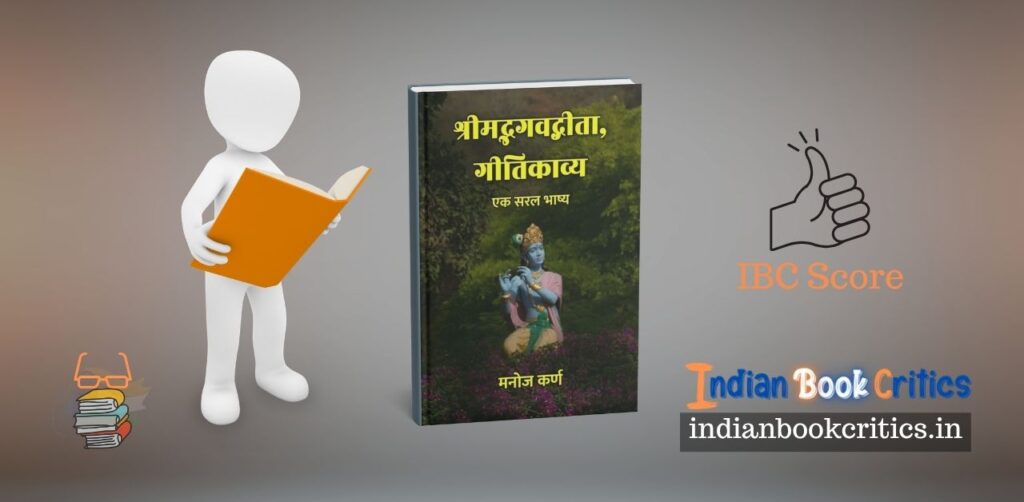
The Bhagavad Gita remains one of the most translated, interpreted, and poetically re-imagined texts in Indian literature and global philosophy. In his ambitious work titled “Shrimad Bhagavad Gita, Geetikavya: Ek Saral Bhashya” (श्रीमद्भगवद्गीता, गीतिकाव्य – एक सरल भाष्य), author Manoj Karn presents a rhymed, metrical, and musically adaptable Hindi poetic commentary (Geya Kavya) on the sacred text. Rather than offering an exhaustive academic commentary or a pedantic word-for-word translation, Karn approaches the text as an internalised spiritual journey rendered in fluid, accessible Hindi verse.
The ethos of Karn’s undertaking is rooted in a modern educational and philosophical necessity. In the introductory authorial note (Apni Baat), the poet frames the Bhagavad Gita not strictly as a sectarian religious scripture, but as a universal guidebook for human life and moral conduct (Jivan jine ki ek sampurna margadarshika). To support this perspective, he references a landmark December 2025 judgment by the Madras High Court, which recognised the Bhagavad Gita as an essential ‘moral science’ (Naitik Vigyan) whose teachings on Vedanta and Yoga transcend religious boundaries and form an integral part of broader Indian civilisational heritage.
Karn’s text aims to bridge the daunting stylistic gap between ancient Sanskrit prosody and the contemporary Hindi reader, particularly children, youth, and families seeking everyday ethical grounding. The result is a literary endeavour that balances spiritual reverence with creative freedom, offering both an 18-chapter poetic commentary and original reflective compositions that extend the narrative universe of the Mahabharata.
A critical evaluation of Shrimad Bhagavad Gita, Geetikavya requires examining its underlying structural architecture and translation methodology. The classical Bhagavad Gita consists of 700 Sanskrit shlokas distributed across 18 chapters. As documented in the book’s preface, these 700 verses are distributed among four speakers: 574 spoken by Lord Krishna, 84 by Arjuna, 41 by Sanjaya, and 1 by Dhritarashtra.
Rather than attempting a literal structural translation (Anuvad), Manoj Karn explicitly clarifies his hermeneutic process:
“मेरे इस पुस्तक को मूल “श्रीमद्भगवद्गीता” का अनुवाद नहीं समझा जाए। मैं पहले पावन गीता के प्रत्येक अध्याय को क्रमबद्ध रूप से आत्मसात किया हूँ, फिर जो भाव प्रकट हुए, उसे मैंने इस पुस्तक में काव्य के रूप में व्यक्त किया है।”
This distinction is central to evaluating the book’s literary character. The poet first internalises the philosophical core of each chapter and subsequently re-expresses its emotional and spiritual resonance through musical Hindi rhyme schemes. The intentional choice of lyrical rhythm ensures that mothers, youth, and children can recite, sing, and easily memorise these core teachings. For this one intention only, the poet has my applause! Manoj has tried to ensure that the Gita, the core of Hindu philosophy, does not remain obscure to those who don’t know Sanskrit.
While this methodology intentionally sacrifices fine-grained scholastic commentary and strict verse-by-verse literalism, it succeeds in preserving the narrative momentum, dramatic tension, and emotional clarity of the original discourse. To maintain thematic fidelity, the poet systematically retains essential Sanskrit terminology such as Karmanyevadhikaraste, Sthitaprajna, Kshetra-Kshetrajna, Ananya Bhakti, and Moksha-Sanyasa, while surrounding them with simplified Hindi verse explanations.
The strength of Manoj Karn’s poetic commentary lies in how effortlessly it translates complex metaphysical doctrines into accessible, emotionally resonant poetry across the key chapters.
A. Crisis and Psychological Realism in Arjun Vishad Yog (Chapter 1)
In the opening chapter, Arjun Vishad Yog, Karn paints a vivid picture of the Kurukshetra battlefield. He captures Arjuna’s sudden existential breakdown when confronted with facing his own elders, teachers, and kinsmen in combat:
“काँप उठी थी उनकी काया, सामने खड़े थे तात, पितामह…
स्वजन सभी थे वही खड़े… देखकर करुणा जगी हृदय में…
पर शस्त्र न, मैं उठाऊँगा, चैन नहीं जब सत्ता पाकर भी,
तो मैं पीछे हट जाऊँगा.. कहकर ऐसा रणभूमि में,
अर्जुन अति व्याकुल हो आए, छूट गया गांडीव हाथ से,
रथ के पीछे जाकर वो सोए..”
Manoj Karn’s poetry effectively conveys Arjuna’s psychological paralysis, transforming an ancient martial scene into a relatable human struggle against grief and moral confusion.
B. Immortality and Duty in Sankhya Yog (Chapter 2)
Moving to Chapter 2, the poet captures Krishna’s divine exhortation regarding the eternal nature of the soul (Atman) and the imperative of duty without attachment (Nishkam Karma). He renders the famous Nainam Chhindanti Shastrani shloka in smooth, rhymed quatrains:
“शस्त्र न इसको काट सकता है, न पावक इसे जलाती है,
जल नहीं इसको भिगो सकता है, और वायु न इसे सुखाती है..
जैसे पुराने वस्त्र बदल, मानव नए वस्त्र धारण करता है,
वैसे ही अजर अमर आत्मा भी, नव देह रूप धारण करता है..”
Here, the imagery of changing worn-out garments maintains the philosophical weight of the Sanskrit original while rendering it in clear, direct language.
C. The Synthesis of Action and Renunciation in Karmayog (Chapter 3) & Moksha Sanyasa Yog (Chapter 18)
A key theme running through the author’s commentary is the practical integration of spiritual wisdom into householder life (Grihasthashram). In Chapter 3 (Karmayog), Manoj emphasises that true renunciation is not about abandoning work, but abandoning egoistic attachment to results:
“कर्मयोग की राह निराली, जीवन को जीवंत बनाती है,
गृहस्थ हो या, हो कोई योगी, दोनों को गले लगाती है..
यहाँ कर्म का त्याग नहीं, पर कर्मफल से न हो आसक्ति..”
This concept is reiterated in Chapter 18 (Moksha Sanyasa Yog), where Krishna defines true sacrifice (Tyaga):
“कर्म छोड़ना त्याग नहीं, श्रीकृष्ण ने यह समझाया है,
कर्मफल आसक्ति छोड़ कर्म करे.. यही सच्चा त्याग बतलाया है..”
By highlighting this distinction, Manoj highlights the text’s practical utility for modern readers who must navigate professional and personal responsibilities without succumbing to stress or burnout.
D. Cosmic Vision and Human Agency in Vishwarupa Darshana Yog (Chapter 11)
In Chapter 11, where Arjuna experiences Krishna’s cosmic form (Vishwarupa), the poet elevates his poetic diction to match the grandeur of the epiphany:
“फल की चिंता मत कर अर्जुन, बस तू एक मनुज पात्र है,
लिखी जा चुकी गाथा रण की, तू तो बस एक निमित्त मात्र है..”
And Krishna reassures the overwhelmed warrior:
“तू कर्ता नहीं, केवल माध्यम है, इस सत्य को पहचान ले…
जीवन पथ के कुरुक्षेत्र में, जब-जब मन घबराएगा,
विश्वरूप दर्शन योग की वाणी, नित संशय दूर भगाएगा..”
This poetic phrasing underscores the psychological reassurance offered by the Gita: viewing oneself as a divine instrument (Nimitta Matra) alleviates the heavy burden of individual ego and existential anxiety.
Beyond the standard 18 chapters, Manoj Karn enriches the volume by inserting original reflective poems that extend the psychological and ethical themes of the epic. These compositions represent some of the most compelling literary achievements in the book.
Psychological Complexity in “Antarmān kā Mahābhārata”
In the poem titled “Antarmān kā Mahābhārata” (अन्तर्मन का महाभारत), Manoj shifts the battlefield from the physical grounds of Kurukshetra to the inner psyche of human conscience. The poem focuses on Draupadi’s profound grief and anger following the war’s destructive aftermath. When Krishna attempts to comfort Panchali, she confronts him over the tragedy:
“सुलग हुआ प्रतिशोध तुम्हारा, कौरव कुल अब शेष नहीं,
विजय मिली है पांडु पुत्रों को, मन में क्यों संतोष नहीं..?
सिसक-सिसक कर बोली कृष्णा, घाव कुरेदने आए हो..?
क्या इस महाविनाश की दोषी, मुझको ही तुम पाए हो..?”
Krishna’s response in Karn’s poem introduces a nuanced moral critique of historical actions, pointing to Draupadi’s past insult of Angraj Karna during the Swayamvara (“Shudra Putra”) and the harsh words spoken at the Mayabhavan as catalytic links in the chain of karma:
“सलाहकार सिर को माधव बोले, पांचाली! क्यों रोती हो..
नियति क्रूर है, कर्म प्रबल हैं, तुम क्यों धीरज खोती हो..?
याद करो उस स्वयंवर को, कर्ण का वह अपमान प्रिये,
शूद्र पुत्र कह तंज कसे जो, क्या न थे, वे महान प्रिये..?”
This poem demonstrates the author’s willingness to engage with the psychological complexities and tragic ironies of the epic, offering readers a space for philosophical reflection.
Destudying Ego in “Sab Prabhu Sankalp Ki Chhaya Hai..”
Another reflective composition, “Sab Prabhu Sankalp Ki Chhaya Hai..” (सब प्रभु संकल्प की छाया है..), explores the mystery of Krishna’s divine chariot and the delusion of human agency. The poem narrates the dramatic moment after the war when Krishna instructs Arjuna to step down from the chariot first. As soon as Krishna steps down, the chariot suddenly bursts into flames and burns to ashes. Krishna explains that the chariot had already been destroyed by divine weapons long ago, but was held together solely by his divine will and the presence of Hanuman on the flag:
“मानव कहता है ‘मैंने किया’, मिथ्या यह उसका अभिमान है…
हम तो बस, एक निमित्त मात्र हैं, सब प्रभु संकल्प की छाया है..”
Through this narrative episode, poet Manoj Karn reinforces the central Gita doctrine: human vanity and the illusion of sole authorship (“I did this”) are false, for all events operate under a higher cosmic ordinance.
Devotional Comfort in “Tu Kyun Karta, Chinta Pyare..”
In the devotional poem “Tu Kyun Karta, Chinta Pyare..”, the poet Manoj Karn draws directly upon Krishna’s assurance of “Mā śucaḥ” (Do not grieve) to offer solace for modern worry and anxiety:
“तू क्यों करता चिंता प्यारे, जब शरण प्रभु के आया है,
कैसी चिंता, कैसा भय है, सब प्रभु संकल्प की छाया है..
‘मा शुच:’ का संदेश यही है, चिंता करना अपराध यहाँ,
प्रभु-शरण में संशय करना, विश्वास पे गहरा दाग यहाँ..”
This composition bridges formal scriptural exposition and popular devotional music (Bhajan), demonstrating the author’s versatile approach to spiritual themes.
Evaluating the book from a prosodic and stylistic standpoint reveals several notable strengths along with specific creative trade-offs:
Accessibility of Diction (Saral Bhashya):
The poet Manoj Karn successfully avoids overly esoteric Sanskritized Hindi, choosing instead clean, melodious, and accessible phrasing. Couplets consistently employ end-rhymes (Tukant Kavita), which establish an easy, natural cadence suitable for oral recitation and group singing.
Integration of Subhashitas and Classical Wisdom:
The author demonstrates a thoughtful appreciation for traditional pedagogy. In his preface, he seamlessly integrates classical Sanskrit verses. For example, the famous Subhashita comparing parents and teachers to potters shaping the clay of a child’s mind (Ghat kup tadaganam karako hi kulalak…) emphasises the role of early character formation.
Inclusivity and Devotional Unity:
In Chapter 12 (Bhakti Yog), Karn handles the classical debate between personal (Sakar) and impersonal (Nirakar) worship with poetic balance:
“चाहे साकार या निराकार हो, दोनों मार्ग की मंजिल एक है,
मन निर्मल और भक्ति भाव हो, तो एक ब्रह्म, सिर्फ जीव अनेक हैं..”
This inclusive perspective makes the work accessible across various devotional traditions.
Critical Trade-Offs & Literary Limitations:
From a rigorous literary standpoint, transforming 700 complex Sanskrit shlokas into fluid rhymed Hindi poetry requires a degree of condensation. Scholars seeking detailed grammatical analysis, word-by-word etymological breakdowns, or technical philosophical debates (Siddhanta) will not find them here. The work prioritises broad emotional resonance, lyrical clarity, and thematic coherence over exhaustive scholastic commentary.
In evaluating the utility of Manoj Karn’s Shrimad Bhagavad Gita, Geetikavya within the contemporary literary and socio-cultural landscape, several factors stand out:
Pedagogical and Family Utility:
In an era dominated by rapid digital consumption, short attention spans, and heightened stress among youth, traditional Sanskrit texts can feel distant or intimidating. By casting the Gita into Geya Kavya (singable poetry), Karn provides parents, educators, and young readers with a user-friendly entry point to moral literature. As noted in the preface, character formation during childhood forms the foundation of ethical citizenship.
Mental Well-Being and Stress Alleviation:
The commentary repeatedly returns to the Gita’s role as a therapeutic framework for the mind—a “Manasik Aushadhi” (mental medicine) that helps alleviate modern anxiety, inner turmoil, and existential doubt. Poems like “Tu Kyun Karta, Chinta Pyare..” directly address contemporary psychological stress, encouraging readers to cultivate inner composure (Sthitaprajna) amid life’s uncertainties.
Alignment with Modern Legal and Cultural Perspectives:
By echoing the Madras High Court’s landmark framing of the Gita as a secular ‘moral science’ (Naitik Vigyan) and cultural heritage rather than a purely dogmatic text, Karn’s work fits neatly into contemporary discussions surrounding values-based education and civilisational ethos.
Contribution to Modern Hindi Devotional Poetry:
The poet adds to a long literary tradition of vernacular Gita adaptations—following in the footsteps of regional saint-poets who brought sacred philosophy out of elite scholar circles and into everyday language. His inclusion of personal narrative poems like “Antarmān kā Mahābhārata” demonstrates how classical epics can continue to inspire creative literary expression today.
Manoj Karn’s “Shrimad Bhagavad Gita, Geetikavya: Ek Saral Bhashya” is a thoughtful, lyrical, and accessible contribution to modern Hindi spiritual literature. Through rhymed metrical verse, clear diction, and expressive narrative poems, Karn succeeds in translating the profound philosophical discourse of Kurukshetra into a practical guide for daily life.
While it does not aim to replace technical academic commentaries or literal line-by-line Sanskrit translations, its true value lies in its literary accessibility, pedagogical utility, and emotional depth. It stands out as an inviting, musical, and inspiring companion for families, young readers, and anyone seeking clarity, moral strength, and mental peace in the modern world.
You may get a copy from Amazon – click here to get a copy now.
Review by Amit Mishra for Indian Book Critics
Shrimad Bhagavad Gita, Geetikavya: Ek Saral Bhashya by Manoj Karn – Review
-
IBC Critical Rating
Summary
The book does what it is supposed to do; it simplifies the obscure philosophical knowledge hidden in the Bhagavad Gita’s Sanskrit verses. Manoj Karn deserves applause from readers who appreciate a simple yet comprehensive Hindi translation of the book, something they can sing, remember, and use to understand its complex spiritual messages.