
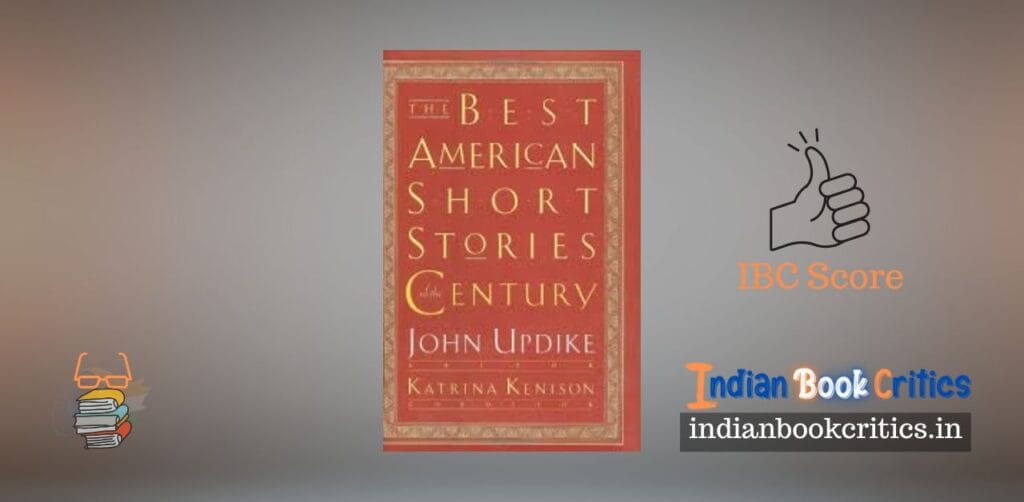
The Best American Short Stories of the Century, edited by John Updike and co-edited by Katrina Kenison, stands as one of the most ambitious and intellectually demanding literary anthologies ever produced in the American context. There are many reasons behind this bold assertion. Conceived not merely as a celebratory collection but as a serious act of cultural judgement, the volume attempts something audacious: to distil nearly a hundred years of American life, sensibility, anxiety, and aspiration into fifty-five short stories chosen from the long-running Best American Short Stories series, not only inviting opinions and atention from lovers of literature but also from anyone who has interest in knowing about the America of the 20th century. The result is not a neutral archive but a canon-making text, one that extracts admiration, argument, and sustained re-reading from the audience.
If I may continue the eulogy in another paragraph, that I won’t, the review may be unnecessarily academic. Therefore, this review approaches the anthology not simply as a list of distinguished stories but as a coherent literary document that reflects the evolution of American consciousness across the twentieth century. What makes this collection exceptional is not only the eminence of the writers included but the way their works, when read together, generate a layered narrative of American modernity—its immigrant roots, racial tensions, moral crises, wars, domestic disillusionments, and artistic reinventions. The anthology rewards both linear reading and selective immersion, offering intellectual pleasure to the seasoned scholar and emotional resonance to the attentive general reader.
Editorial Vision and Canonical Ambition
John Updike’s introduction is itself a critical essay of considerable depth. He is transparent about the arbitrariness and burden of selection, acknowledging that these stories have been “four times selected” before reaching the reader. This honesty is important, for it frames the anthology not as an infallible list of “the best,” but as a highly informed, deeply reflective judgement made by a writer-critic acutely aware of the short story’s historical fragility and cultural significance.
Updike’s two guiding principles—roughly equal representation across decades and a firm anchoring in American or North American experience—shape the anthology in discernible ways. The result is a chronological movement that allows readers to trace shifts in style, theme, and narrative confidence. From early immigrant narratives to postmodern fragmentation and late-century existential unease, the anthology reads almost like a compressed social history of the United States, written not in facts but in human situations.
Early Voices and the Immigrant Imagination
The anthology opens with Benjamin Rosenblatt’s “Zelig” (1915), a story that immediately establishes the emotional seriousness of the collection. Zelig, a Jewish immigrant consumed by the dream of returning home, embodies the psychological cost of displacement. His obsessive thrift, emotional paralysis, and eventual moral awakening through his grandson form a devastating portrait of alienation softened only at the very end by an act of whispered generosity: “Tomorrow I will give you the money for the college.” This moment, restrained and understated, encapsulates a recurring American theme—the painful negotiation between old-world memory and new-world possibility.
Mary Lerner’s “Little Selves” continues this introspective mode, focusing on mortality, memory, and suppressed emotional life. The story’s quiet dignity and religious undertones reflect a period when inner life, rather than dramatic action, carried narrative weight. Together, these early stories remind the reader that American literature did not begin in confidence but in uncertainty, marked by voices trying to make sense of belonging in a rapidly changing society.
Race, Violence, and Moral Reckoning
Few stories in the anthology are as disturbing—or as necessary—as Jean Toomer’s “Blood-Burning Moon” and Richard Wright’s “Bright and Morning Star.” Toomer’s story, with its stark racial symbolism and tragic inevitability, exposes the brutal undercurrents of American racial history. The moon itself becomes a silent witness to lynching and desire, its “blood-burning” glow illuminating the inescapability of violence in a racially divided world.
Wright’s “Bright and Morning Star” is perhaps one of the most emotionally harrowing pieces in the collection. Set against the backdrop of Communist organising in the American South, the story focuses on Sue, an elderly Black woman whose loyalty to her sons and their political cause leads her toward martyrdom. Lines such as “She stood alone in the darkness, her heart heavy but unyielding” capture the story’s moral gravity. Wright does not romanticise suffering; instead, he insists on its historical specificity, reminding readers that ideology, race, and survival were tragically entangled in twentieth-century America.
Modernist Compression and Psychological Depth
The interwar period brings some of the most formally accomplished stories in the anthology. Ernest Hemingway’s “The Killers” remains a masterclass in narrative restraint. Its clipped dialogue, surface simplicity, and pervasive sense of menace demonstrate Hemingway’s belief that meaning lies beneath what is said. The story’s refusal of closure—Ole Andreson’s passive acceptance of death—marks a significant shift in American storytelling, one that privileges existential awareness over moral resolution.
William Faulkner’s “That Evening Sun Go Down” offers a contrasting density. Through fragmented narration and childlike perspective, Faulkner builds an atmosphere of dread that reflects both personal fear and collective guilt. Nancy’s terror is never fully explained, yet it saturates the narrative, suggesting that in the American South, danger often exists unspoken, woven into the social fabric.
Katherine Anne Porter’s “Theft” deserves special mention for its emotional precision. The story captures a woman’s painful clarity about her own emotional emptiness. The line “She knew now why she had felt so lost all evening” resonates long after the story ends, exemplifying Porter’s ability to articulate psychological states without melodrama.
Domestic Life and Postwar Disillusionment
The postwar decades introduce stories that interrogate domestic stability and moral complacency. John Cheever’s “The Country Husband” is exemplary in this regard. Beneath its suburban setting lies a profound unease, as the protagonist’s brush with death destabilises his sense of normalcy. Cheever’s prose, elegant and ironic, reveals how spiritual crisis can erupt in the most orderly environments.
Flannery O’Connor’s “Greenleaf,” by contrast, uses grotesque imagery and religious symbolism to confront spiritual blindness. Mrs. May’s violent encounter with the bull is both literal and allegorical, a moment of divine intrusion that O’Connor renders with unsettling clarity. The story’s closing image—of revelation arriving through destruction—remains one of the most striking in American short fiction.
Jewish-American Voices and Ethical Inquiry
Mid-century American fiction is unthinkable without its Jewish voices, and the anthology honours this tradition with works by Bernard Malamud, Philip Roth, Saul Bellow, and Isaac Bashevis Singer. Malamud’s “The German Refugee” stands out for its moral seriousness and emotional restraint. The refugee’s despair, shaped by exile and intellectual displacement, culminates in a tragic ending that refuses easy consolation.
Singer’s “The Key” offers a gentler, almost mystical counterpoint. The story transforms a mundane event into a spiritual epiphany, reminding readers of fiction’s capacity to uncover wonder in the ordinary. Singer’s prose, deceptively simple, carries the weight of cultural memory and religious symbolism with remarkable grace.
Minimalism, Fragmentation, and Late-Century Anxiety
The latter sections of the anthology reflect a noticeable stylistic shift. Raymond Carver’s “Where I’m Calling From” exemplifies minimalist restraint, presenting addiction and recovery without overt judgment. Its power lies in what is left unsaid, in the silences between lines. Ann Beattie’s “Janus” similarly relies on emotional understatement, portraying marital disintegration through small, telling details.
Cynthia Ozick’s “The Shawl” represents a different kind of compression—moral and historical rather than stylistic. In just a few pages, Ozick confronts the Holocaust with devastating intensity. The image of the shawl as both comfort and death-object lingers painfully, demonstrating how short fiction can bear the weight of historical trauma.
Among the most moving late-century stories is Alice Elliott Dark’s “In the Gloaming.” Its portrayal of a mother caring for her dying son is marked by tenderness and restraint. The line “She loved him with a fierce, quiet love” encapsulates the story’s emotional core. Unlike more overtly political narratives, Dark’s story insists on the dignity of private grief, offering a deeply human conclusion to the century’s literary journey.
Final Assessment
The Best American Short Stories of the Century is not merely an anthology; it is a serious intellectual intervention into how American literature is remembered and valued. While no such collection can be exhaustive or uncontested, the choices made here are defensible, thoughtful, and often inspired. The anthology captures the short story’s unique ability to register social change through individual lives, to compress vast historical forces into moments of recognition, fear, or grace.
What compels most across the volume is its emotional range. Stories such as “Zelig,” “Bright and Morning Star,” “The Killers,” “Greenleaf,” “The Shawl,” and “In the Gloaming” do not simply impress; they unsettle, linger, and demand ethical engagement. They remind the reader that the American short story, at its best, is neither ornamental nor escapist but profoundly serious in its attention to human consequence.
For scholars, the anthology offers a ready-made syllabus of American literary evolution. For general readers, it provides a deeply moving encounter with the voices that have shaped a century’s imagination. Above all, it affirms the enduring relevance of the short story as a form capable of capturing the complexities of human experience with unmatched intensity and precision.
Review by Amit Mishra for the Indian Book Critics platform
Thanks for reading!