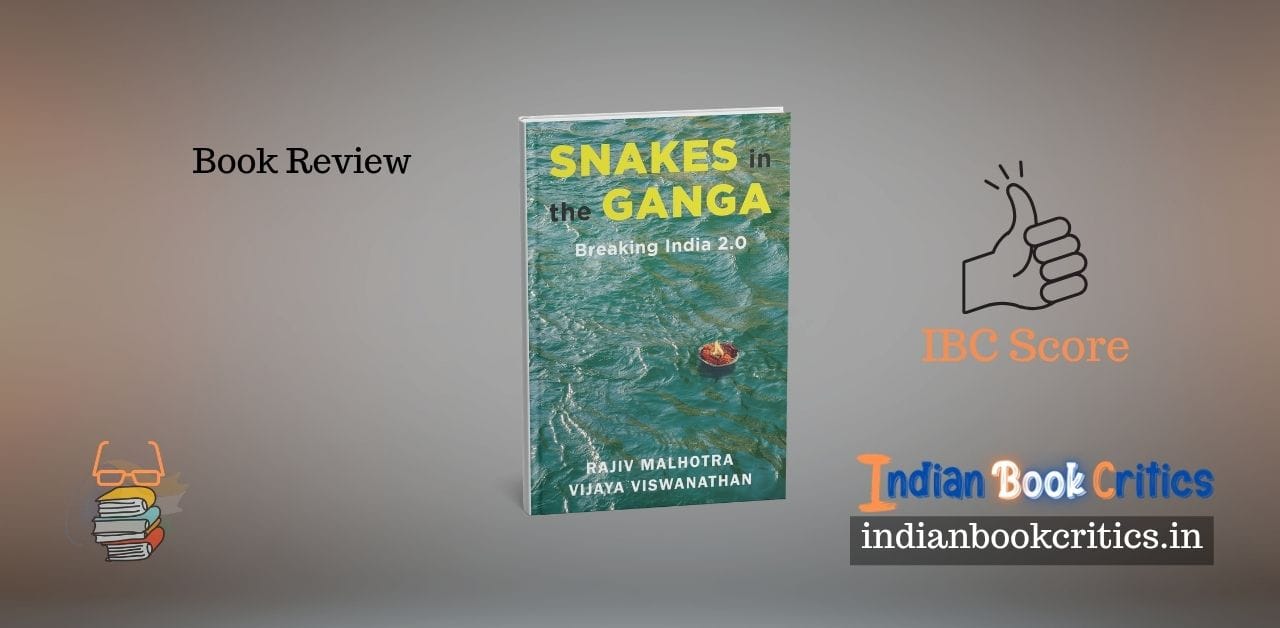
Snakes in the Ganga: Breaking India 2.0 by Rajiv Malhotra and Vijaya Viswanathan is a work that demands to be read with attentiveness, patience, and a willingness to engage with arguments that are both provocative and expansive in scope. Well, I would like to reluctantly add one more prerequisite to reading this book – if you are an observing person and take an interest in affairs beyond your personal periphery and directly or indirectly relate to the country, reading this book might make more sense than the possibility in an otherwise scenario. The book situates itself within a broader intellectual and political discourse concerning the evolving nature of ideological influences on India, particularly those emanating from Western academic and institutional spaces. At its core, it attempts to map a complex network of ideas, institutions, and actors that, according to the authors, contribute to shaping narratives about India in ways that may not always be benign or neutral. As one reads through its dense chapters, it becomes clear that this is not merely a continuation of earlier concerns raised in Breaking India, but an effort to reframe those concerns within a new global context marked by the rise of Critical Race Theory, identity politics, and transnational academic collaborations.
One of the most striking aspects of the book is its insistence on connecting seemingly disparate developments into a cohesive framework. The authors argue that India today stands at a critical juncture, where imported sociological theories are once again influencing its internal dynamics. They write, “India, once again, is at the threshold of importing a large-scale sociological doctrine along with its varied practices”. This observation serves as a foundational premise for the entire narrative. What follows is an elaborate attempt to trace how such doctrines have historically entered India and reshaped its socio-political landscape, from colonial interpretations of caste to the later adoption of Marxism and postcolonial theories. The tone here is not alarmist, but it does carry a sense of urgency, as if the authors are urging readers to recognise patterns that might otherwise go unnoticed. And luckily, if you are attentive in your observations, you might start seeing the patterns that Rajiv and his co-author highlight.
The book’s engagement with Critical Race Theory forms one of its central pillars. Malhotra and Viswanathan present a detailed critique of how this framework, originally developed in the United States to address racial injustices, is being adapted to the Indian context. They argue that this adaptation is neither straightforward nor entirely appropriate, given the vast historical and cultural differences between the two societies. In a particularly revealing passage, they note that “something as seemingly idealistic and humanistic as Critical Race Theory (CRT) is being exploited to break down a society built over several millennia”. Though it becomes difficult for a serious reader to disagree with this assessment, it is further difficult to deny that the authors raise important questions about the transferability of theoretical models across contexts. Their analysis alerts readers to consider how and why the relentless import of socio-economic policies and ideologies from the West might not be the best-suited solution for the complex society that India is!
Another important contribution of the book lies in its examination of institutional influence, particularly that of elite universities. Harvard University emerges as a recurring focal point in the narrative, not merely as an academic institution but as a significant node in a global network of knowledge production and dissemination. The authors suggest that such institutions play a crucial role in shaping discourses that eventually permeate policy, media, and public opinion. They observe that “Harvard has become the academic nexus for this project”, a statement that encapsulates their broader argument about the centralisation of intellectual authority. This focus on institutional dynamics adds a layer of complexity to the book, moving it beyond abstract theorising into the realm of concrete analysis. It invites readers to consider how knowledge is produced, who controls it, and what implications it might have for societies like India.
The narrative also devotes considerable attention to the idea of identity and its politicisation. Through detailed discussions of caste, race, and other social categories, the authors explore how identities can be mobilised within larger ideological frameworks. They argue that the mapping of caste onto race, a key feature of what they term “Critical Caste Theory,” represents a significant shift in how Indian society is being interpreted. This is not presented as a simple academic exercise, but as a development with far-reaching consequences. The book suggests that such frameworks may contribute to new forms of social fragmentation, even as they claim to address historical injustices. In one of the more reflective moments, the authors note that “the ecosystems are well-managed and efficient, and operate across national boundaries at the speed of light”, highlighting the global nature of these processes.
At the same time, the book does not entirely dismiss the motivations behind these theoretical approaches. There is an acknowledgement, albeit limited, that many of these frameworks originate from genuine concerns about inequality and injustice. The critique is directed less at the intentions and more at the consequences of their application in contexts for which they were not originally designed. This nuanced position allows the authors to maintain a certain degree of balance, even as they advance a clearly defined argument. It also makes the book accessible to readers who may not share all of its conclusions but are interested in understanding the issues it raises.
One of the more engaging elements of the book is its use of case studies and illustrative examples. These sections provide a sense of immediacy and concreteness that complements the broader theoretical discussions. For instance, the authors examine the role of various organisations, funding networks, and individual actors in shaping the discourse around India. They also discuss the involvement of Indian elites in supporting these initiatives, raising questions about the motivations behind such engagements. In a candid observation, they remark that “sometimes philanthropy has unintended outcomes”. This line captures the ambivalence that runs throughout much of the book, in which ostensibly benevolent actions are scrutinised for their potential long-term effects.
The book’s writing style deserves mention as well. While it is rooted in academic research and supported by extensive documentation, it does not adopt an overly technical or inaccessible tone. Instead, the authors employ a conversational style that allows complex ideas to be communicated with relative clarity. This balance between rigour and readability is one of the book’s strengths. It enables a wider audience to engage with its arguments without feeling overwhelmed by jargon or excessive abstraction. At the same time, the density of information means that the book demands careful reading, and it may not be suitable for those looking for a quick or superficial overview.
Another dimension worth noting is the book’s attempt to situate its arguments within a historical continuum. By tracing the evolution of various intellectual movements and their impact on India, the authors provide a sense of continuity that enriches their analysis. They suggest that the current moment is not entirely unprecedented, but part of a longer trajectory of external influences and internal adaptations. This historical perspective adds depth to the discussion and helps readers understand the broader context in which contemporary debates are unfolding.
To end this review, I will just recommend it without ifs and buts! Snakes in the Ganga is a thought-provoking and meticulously argued work that engages with some of the most pressing questions facing India today. It is not a book that offers easy answers or definitive conclusions. Instead, it invites readers to think critically about the forces shaping their society and to consider the implications of engaging with global intellectual trends. Whether one agrees with its arguments or not, the book succeeds in stimulating discussion and encouraging a more reflective approach to complex issues. As the authors themselves suggest, “the picture must be understood in its entirety rather than piecemeal”, and it is perhaps this insistence on holistic understanding that constitutes the book’s most valuable contribution.
Get a copy from Amazon India – click here.
Review by Manish for Indian Book Critics
Snakes in the Ganga: Breaking India 2.0 by Rajiv Malhotra and Vijaya Viswanathan – A Detailed Review
- IBC Critical Rating
Summary
Recommended, well-researched, factual, and argumentative in a productive manner! In short, a MUST-READ Book!