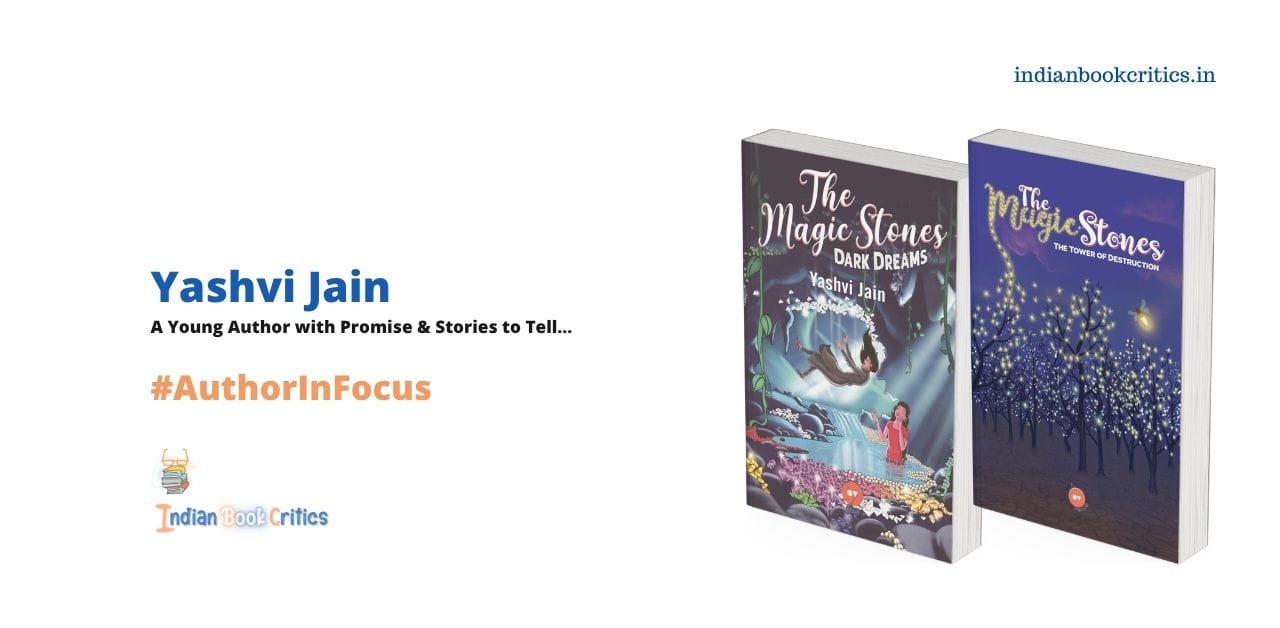
At eleven, Yashvi Jain had a problem familiar to an avid reader but solved by very few: she had run out of books she wanted to read.
She had already developed a strong preference for mystery, fantasy, suspense and humour, and when the worlds available to her began to feel exhausted, she decided to create one of her own. That impulse resulted in The Magic Stones, the first book in a fantasy-adventure series that has now grown to two published volumes. The Magic Stones II: The Tower of Destruction followed, while Yashvi is currently working on the third instalment.
The story behind the books is appealing in its simplicity. A young reader wanted more stories and became a writer. But the more interesting story lies beyond that origin. Yashvi Jain is not merely an unusually young author who has managed to publish two books. She is a young writer beginning to develop a distinct idea of what fiction should do, particularly for young readers.
Her ambition is not limited to creating fantastical worlds. She wants those worlds to unsettle easy assumptions about morality, identity and the distinction between heroes and villains.
That ambition deserves attention.
The imagination of a reader
Yashvi’s understanding of authorship begins with reading. She describes herself as an avid reader who, after exhausting the books that appealed to her, began wondering whether she could create the worlds she was looking for herself.
That instinct is visible throughout The Magic Stones. The first novel places Flora and her friend Rosy in an apparently ordinary setting, a Halloween carnival. The familiar setting gradually acquires the characteristics of a mystery. A prankster is frightening visitors, clues begin to appear, and the protagonists find themselves investigating what initially appears to be a relatively straightforward crime.
The progression from the familiar to the fantastical is one of the book’s useful narrative devices. The reader is given something recognisable before being introduced to the larger imaginative world. Flora’s telekinetic abilities, the mysterious clues, supernatural encounters and the eventual discovery of a much larger secret gradually widen the scope of the story.
Yashvi also understands the value of movement. Her protagonists rarely remain passive for long. They investigate, follow clues, make mistakes, escape traps and enter unfamiliar spaces. The narrative consequently has the forward momentum expected of children’s adventure fiction.
Her prose is similarly energetic. Characters frequently respond to danger with jokes, sarcasm and spontaneous observations. This is especially evident in the relationship between Flora and Rosy. Their friendship provides much of the humour of the books and prevents the narrative from becoming excessively solemn.
A particularly revealing episode in the first book involves the girls navigating a cemetery populated by zombies while searching for another clue. Rosy’s irreverent attempt to distract the zombies, followed by Flora’s discovery of the clue in an unexpected place, illustrates Yashvi’s preference for combining suspense with comic relief.
The result is a narrative voice that is unmistakably youthful. That is both its charm and, at times, its limitation.
A world that becomes larger with the second book
The difference between the first and second books is important because it reveals Yashvi’s development as a writer.
The first book is comparatively contained. Its central mystery begins at a carnival and gradually leads the protagonists towards the supernatural world underlying their experience.
The Magic Stones II, by contrast, significantly expands the mythology. Flora and Rosy enter Astrolen, encounter the Dark Dreams and their leader Dolores, discover more about their own abilities and become involved in the survival of an entire population. The magic stones themselves acquire greater significance, while the Astrolen gem becomes central to the conflict. The book’s own synopsis describes the protagonists’ attempt to save Astrolen while new truths about their world emerge.
The expansion is not merely geographical. Yashvi also introduces a more elaborate system of magical rules. Different characters possess different abilities, the magic stones have specific functions, and the protagonists must learn how their powers operate.
This gives the series the beginnings of a mythology rather than leaving it as a collection of disconnected adventures.
There are particularly effective moments when the mechanics of the fantasy world become part of the suspense. Flora must understand the limits of her powers, while the characters gradually discover the relationship between their physical characteristics and their abilities.
The second book therefore demonstrates an important progression: Yashvi is moving from inventing adventures to constructing a fictional world.
That distinction matters for a writer attempting a series.
The moral questions beneath the fantasy
The most promising element of Yashvi’s conception of her fiction is her stated reluctance to divide the world neatly into heroes and villains.
She explicitly wants her young readers to question such categories. In her view, the purpose of the series is not simply to establish one side as good and another as evil, but to create situations in which readers have to consider why people behave as they do and whether moral choices are always as straightforward as they appear.
There is evidence of this developing concern in the second book.
The Tower of Destruction, for instance, introduces a situation in which prisoners are forced to maintain a structure whose destruction could kill people outside it. Flora considers the apparent alternatives: sacrificing oneself so that others can live, or continuing to live under intolerable conditions. She then questions whether such circumstances can meaningfully be described as a choice at all.
This is one of the stronger conceptual moments in the series because the fantasy setting becomes a vehicle for an ethical question.
Similarly, Flora and Rosy do not automatically trust the guardians of Astrolen. The guardians need their help, but the girls have already been deceived and abducted. Rosy consequently questions why they should trust people who have withheld information from them. Flora, too, hesitates before deciding whether they should intervene.
These moments complicate the conventional architecture of children’s fantasy. The protagonists are not simply told whom to trust and whom to oppose. They have to decide.
That is particularly appropriate for the age group Yashvi wants to reach.
Writing without lecturing
Yashvi’s stated philosophy of storytelling is perhaps more interesting than her biography.
She believes stories can communicate moral questions more effectively than direct instruction because they allow readers to arrive at their own conclusions. That distinction is important. Children’s fiction becomes considerably less interesting when it turns into a disguised lecture.
Yashvi’s approach is to place the questions inside the action.
The characters encounter situations involving trust, responsibility, fear, sacrifice and power, and the reader encounters those questions alongside them. Flora’s supernatural abilities are therefore not simply devices for making the story exciting. They also create problems of responsibility. In The Magic Stones II, Flora becomes conscious of the possibility that her powers could cause harm and worries about losing control of them.
The idea of power carrying responsibility is hardly new in literature, of course. What is notable here is that Yashvi is consciously attempting to introduce such questions into a fantasy series intended for young readers.
Her fiction consequently occupies an interesting middle ground. It wants to offer the pleasures traditionally associated with children’s fantasy, adventure, humour, supernatural abilities and mysterious worlds, while simultaneously encouraging readers to question some of the assumptions built into that genre.
The unmistakable strengths of a young writer
Yashvi’s strongest quality at present is imagination.
Her fictional world is populated with enough characters, powers, objects, settings and mysteries to demonstrate that she does not suffer from a shortage of ideas. She is also comfortable generating narrative situations rapidly. A carnival can become a crime scene; a clue can lead to a supernatural passage; a magical stone can become a portal; an unfamiliar world can suddenly become a matter of survival.
Her second strength is her instinct for accessibility. She writes from the perspective of young protagonists and allows them to behave like young people. They joke, argue, become frightened, misunderstand situations and question adults. This makes the books accessible to the audience for which they are intended.
Her third strength is curiosity. The stories repeatedly operate through questions: Who is responsible? What does this object do? Who can be trusted? What lies beyond the next portal? Why are the characters being kept in the dark?
That curiosity is fundamental to both mystery and fantasy, and Yashvi brings the two genres together naturally.
There is also a noticeable willingness to experiment with the scale of her fiction. The second book does not simply repeat the first book’s formula. It enlarges the world and raises the stakes.
Where the writer still has room to grow
A fair assessment, however, should not confuse promise with accomplishment.
Yashvi is still developing as a prose stylist. The energy of her writing sometimes produces long, crowded passages in which action, dialogue, description and internal reaction arrive in quick succession. Some scenes could benefit from greater restraint, more deliberate pacing and tighter sentence construction. At times, the prose tells the reader what a character is feeling rather than allowing the situation itself to produce the emotion.
There is also a tendency towards repetition, particularly in dialogue and descriptions of reactions. These are natural characteristics of an emerging writer, but they are precisely the areas in which sustained reading and revision can produce significant improvement.
The important point is that these are craft issues, not deficiencies of imagination.
Indeed, the distinction is crucial. Imagination cannot easily be taught. Sentence control can.
As Yashvi reads more widely and develops a more critical relationship with her own drafts, the raw abundance of ideas in her fiction can be accompanied by greater economy, precision and psychological depth. Her stated interest in moral ambiguity could also become increasingly sophisticated if future books allow characters’ motivations to become more complex rather than simply announcing that the distinction between good and evil is uncertain.
That is where her literary development may become especially interesting.
A writer with an unusual academic trajectory
There is another intriguing dimension to Yashvi’s present life. She is currently completing the International Baccalaureate Diploma Programme, studying Higher Level Computer Science, Physics and Mathematics AA, alongside English Literature, Economics and French B at Standard Level. She intends to study computer science at university and pursue a future in AI programming.
At first glance, this seems distant from fantasy writing. In practice, the connection may be less surprising.
Both computer science and world-building involve systems, structures and relationships. Yashvi’s fictional worlds operate according to rules. Powers have particular characteristics, magical objects have particular functions, and actions produce consequences.
Her interest in technology is already compatible with the structural imagination evident in the books. In The Magic Stones II, for example, Flora attempts to understand her powers through the metaphor of energy levels, distinguishing between different forms of physical and mental energy as she considers how much she can expend.
Whether her future lies primarily in computer science, literature or some combination of the two remains to be seen. At present, there is no need to force a connection between them. It is enough to observe that both disciplines demand curiosity, systems thinking and the willingness to imagine what does not yet exist.
The beginning, rather than the achievement
Yashvi Jain’s two books should therefore be read neither as a curiosity nor as evidence that she has already arrived as a finished writer.
They are something more interesting: evidence of a writer in formation.
Her achievement is not simply that she began writing young. It is that she has sustained a fictional universe across two books and has begun to think seriously about the kind of stories she wants to tell and the effect those stories might have on young readers.
The dedication of both books to readers who have “always wanted to be different” is revealing in this respect. It captures something fundamental about the project. Yashvi’s fiction is built around characters who enter unfamiliar worlds, discover unusual abilities and are forced to reconsider what they know about themselves and others.
That is also an apt description of the writer herself.
She began as a reader looking for another world. She responded by constructing one. The first book gave her an adventure; the second gave that adventure a larger mythology and more serious moral questions. The third instalment now offers her another opportunity to refine not merely the world of The Magic Stones, but her own craft as a novelist.
What happens next will depend less on the novelty of being a young author and more on what she does with the considerable imagination she already possesses.
The worlds are there. The questions are beginning to emerge. The next stage is learning how to write them with the precision they deserve.
Ashish for Indian Book Critics