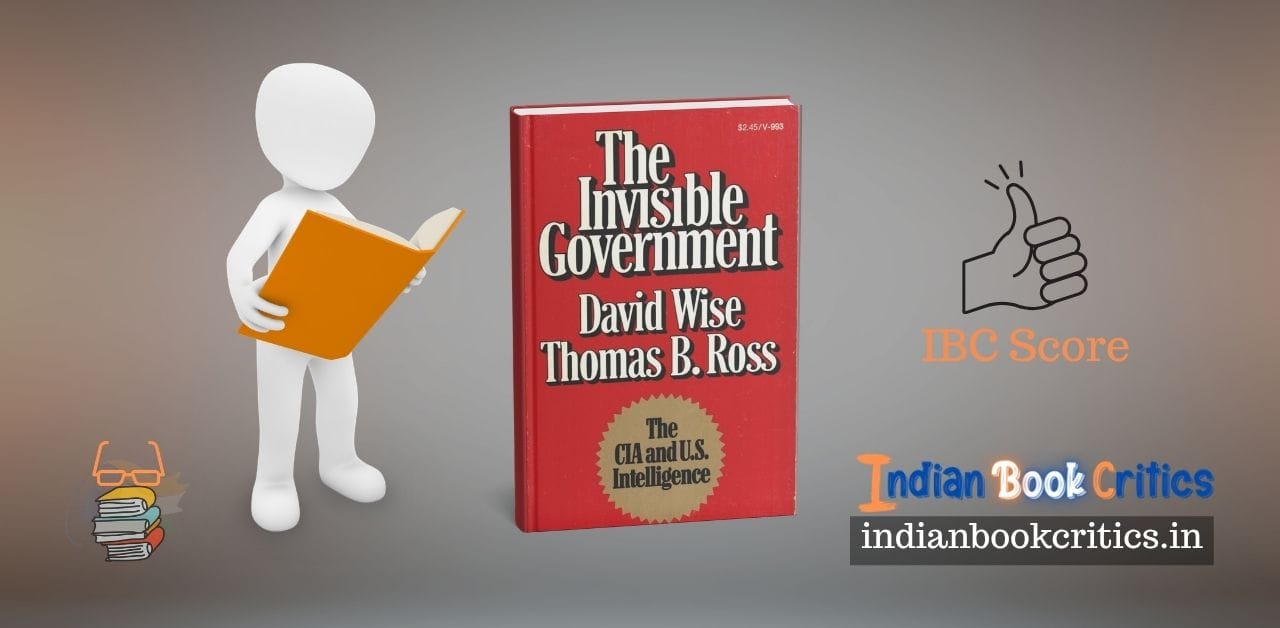
There are books you read for information, and then there are books that quietly rearrange how you look at power itself. The Invisible Government belongs firmly in the second category. When I first picked it up, I expected a historical account of intelligence agencies during the Cold War. What I encountered instead was something far more unsettling. It was a carefully documented argument that a significant portion of American power operated outside public scrutiny, beyond electoral accountability, and often without the informed consent of citizens.
Written by David Wise and Thomas B. Ross in 1964, the book arrived at a time when the Central Intelligence Agency was still largely shielded from public criticism. The Cold War had created an atmosphere in which secrecy was not only accepted but actively encouraged. National security became a justification for silence. In that climate, to suggest that intelligence agencies were operating as a kind of parallel government sounded, to many, like exaggeration.
Yet what makes this book remarkable is not its tone of alarm, but its restraint. Wise and Ross do not indulge in speculation. They build their case slowly, using documented incidents, policy decisions, and observable patterns of behaviour. The result is not a dramatic exposé in the conventional sense. It is something more persuasive. It reads like a careful unveiling of a system that prefers to remain unseen.
At the centre of the book lies a simple but powerful idea. There exists, alongside the visible structures of democracy, an “invisible government” composed of intelligence agencies and covert operations that exert influence over foreign policy and, at times, domestic perception. This is not presented as a conspiracy in the sense of a secret cabal meeting in hidden rooms. It is presented as a structural reality. Decisions are made, actions are taken, and policies are shaped without the transparency that democratic systems are supposed to ensure.
The authors take the reader through a series of Cold War episodes that illustrate how this invisible system functioned. They discuss covert interventions in foreign countries, the manipulation of political outcomes, and the use of propaganda as a strategic tool. What stands out is not just the existence of these operations, but the degree to which they were insulated from public knowledge.
One of the most striking aspects of the book is its discussion of how intelligence agencies interacted with media and information channels. At the time of publication, the idea that the CIA might influence journalists or shape narratives seemed difficult to accept. It challenged the assumption that the press operated independently as a check on power. Wise and Ross did not claim that all media was controlled, but they suggested that certain relationships existed that allowed for subtle influence.
Years later, investigations such as the Church Committee would bring many of these concerns to light. The Committee’s findings revealed that intelligence agencies had indeed engaged in media influence operations and covert propaganda efforts. What had once sounded like suspicion began to look like early documentation of a reality that had not yet been publicly acknowledged.
Reading The Invisible Government today, with the benefit of hindsight, creates a strange experience. You are aware that many of the book’s claims were initially dismissed or minimised. Yet you also know that later declassifications, congressional investigations, and journalistic inquiries confirmed significant parts of what the authors described. This does not mean that every detail in the book was complete or perfectly accurate. No work of investigative journalism can claim that. But it does mean that the central thesis was grounded in something real.
The book also raises an important question about how democracies function under conditions of secrecy. Intelligence agencies operate in a world where information is currency. Their effectiveness often depends on their ability to act without revealing their intentions. This creates a tension. On the one hand, secrecy can be necessary for national security. On the other hand, excessive secrecy can erode accountability.
Wise and Ross do not offer simple solutions to this dilemma. Instead, they highlight its existence. They show how easily the balance can shift. When decisions are made behind closed doors, when operations are classified, and when information is withheld, the line between necessary secrecy and unaccountable power becomes difficult to draw.
Another strength of the book lies in its refusal to sensationalise. It would have been easy to frame the narrative in dramatic terms, to present intelligence agencies as shadowy villains controlling every aspect of political life. The authors resist this temptation. They present a more complex picture. Intelligence agencies are shown as institutions with their own logic, driven by strategic concerns and shaped by the pressures of global conflict.
This complexity makes the book more credible. It does not ask the reader to accept a grand theory of hidden control. It asks the reader to observe patterns, to consider evidence, and to think critically about the structures of power that operate beyond visibility.
One of the most interesting aspects of reading this book today is how it anticipates later developments in public discourse. In the decades since its publication, there has been increasing awareness of intelligence operations, surveillance programs, and covert interventions. Revelations about programs such as MKUltra, COINTELPRO, and various foreign policy operations have contributed to a broader understanding of how intelligence agencies function.
In this context, The Invisible Government feels less like a controversial claim and more like an early map of a territory that would later be explored more widely. It captures a moment when these issues were beginning to surface but had not yet entered mainstream awareness.
The book also invites reflection on the nature of trust. Democracies rely on a certain level of trust between citizens and institutions. When that trust is undermined by secrecy or deception, the consequences can be long-lasting. Wise and Ross do not argue that all secrecy is harmful. They suggest that secrecy without oversight can lead to decisions that escape public scrutiny.
This concern remains relevant today. Modern discussions about surveillance, data collection, and national security continue to grapple with similar questions. How much should citizens know about the actions of their government? What level of secrecy is justified? Who ensures that power is not misused?
Reading The Invisible Government does not provide definitive answers to these questions. What it does provide is a framework for thinking about them. It encourages readers to look beyond official narratives and consider the structures that shape them.
The writing itself is clear and accessible. Wise and Ross do not rely on technical jargon or overly complex explanations. They guide the reader through their argument with patience, building each point on the previous one. This makes the book approachable even for those who may not be familiar with the details of Cold War politics.
At the same time, the simplicity of the prose should not be mistaken for simplicity of thought. The ideas presented in the book are layered and require careful consideration. The more one reflects on them, the more their implications become apparent.
What stays with you after finishing the book is not a sense of fear, but a sense of awareness. You begin to notice how easily certain aspects of power remain hidden. You become more attentive to the relationship between information and authority.
It is also worth noting that the book does not claim that intelligence agencies operate entirely without constraint. There are references to oversight mechanisms and internal debates. However, the authors suggest that these mechanisms are not always sufficient to ensure full accountability.
This nuanced approach is important. It prevents the discussion from becoming polarised. The book does not ask readers to reject institutions entirely. It asks them to engage critically with those institutions.
In many ways, The Invisible Government can be seen as part of a broader tradition of investigative journalism that seeks to illuminate hidden aspects of power. It stands alongside other works that have used documents, testimonies, and careful analysis to challenge official narratives.
What distinguishes it is its timing. It appeared before many of the revelations that would later confirm its concerns. In that sense, it functions both as a historical document and as a precursor to later investigations.
For readers today, the book offers an opportunity to revisit a moment when certain ideas were still emerging. It allows you to see how perceptions of power have evolved. It also reminds you that what is considered unlikely or implausible in one era may become accepted knowledge in another.
If you approach the book expecting dramatic revelations at every turn, you may find it quieter than anticipated. Its strength lies not in shocking the reader, but in steadily reshaping their understanding. It does not rely on spectacle. It relies on accumulation.
By the end, you are left with a clearer sense of how intelligence, secrecy, and policy intersect. You may not agree with every implication drawn by the authors, but it becomes difficult to dismiss the questions they raise.
That, perhaps, is the lasting achievement of The Invisible Government. It does not demand belief. It invites attention. And once you begin paying attention, the idea that power can operate invisibly no longer feels like a distant possibility. It feels like something that has always been there, waiting to be noticed.
Review by Aditya for Indian Book Critics