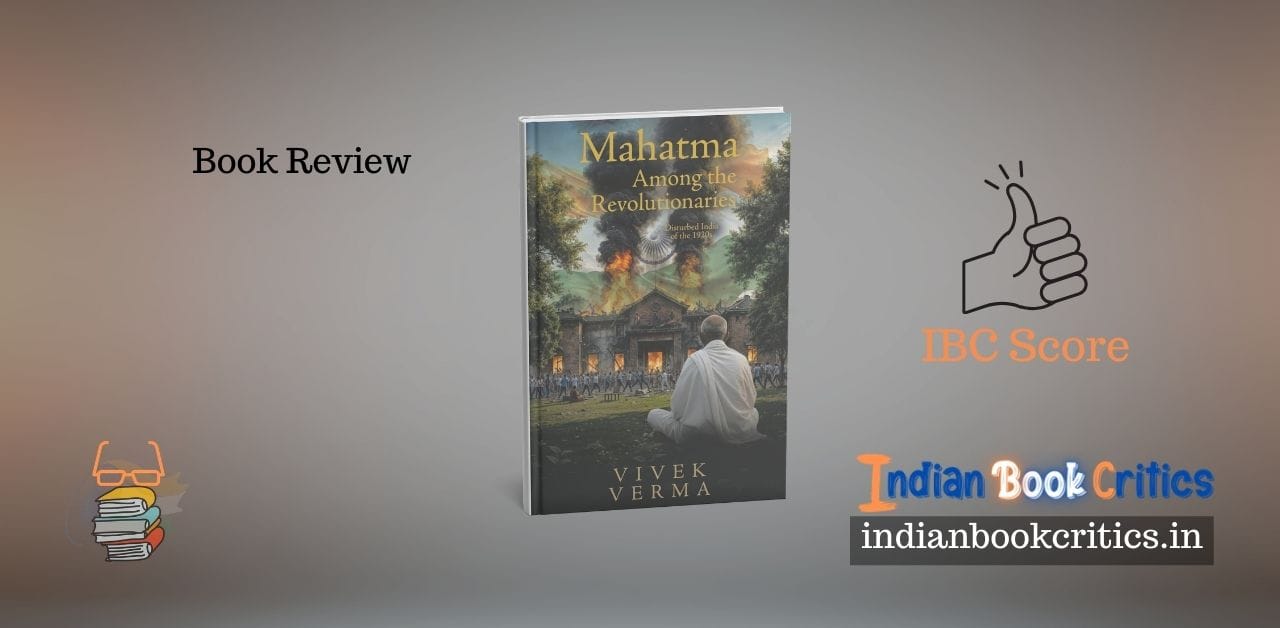
Mahatma Among the Revolutionaries is an ambitious and intellectually provocative reconstruction of one of the most contested decades in India’s modern history. Vivek Verma undertakes the difficult task of narrating the freedom struggle not as a harmonious movement led by a singular moral centre, but as a turbulent convergence of competing visions, strategies, and emotional intensities. The result is a work that inspires in the readers an admiration for its depth and scope, while also demanding critical engagement with its interpretive choices. It is a book that deliberately unsettles settled narratives, yet in doing so, it occasionally risks overwhelming its reader with the very complexity it seeks to restore. That tension, however, is precisely what makes this historical account worthy of sustained attention.
At the heart of Vivek Verma’s narrative lies an insistence that the Indian freedom struggle cannot be understood through the lens of inevitability. The author repeatedly returns to the idea that British rule in India was sustained not by moral legitimacy but by strategic necessity. The inclusion of George Curzon’s stark confession that British India was the “true fulcrum of Asian dominion” and that the loss of India would reduce Britain to “a third-rate power” establishes from the outset that imperial governance was anchored in global power calculations rather than civilising ideals. This framing is one of the book’s most persuasive elements. By foregrounding imperial anxiety, Verma compels readers to reassess the conditions under which Indian resistance emerged. Independence appears less as a benevolent concession and more as a reluctant response to sustained pressure.
The narrative’s treatment of colonial violence is equally unflinching. General Reginald Dyer’s admission that he intended to “make a wide impression… throughout the Punjab” and to “reduce their morale” stands as a chilling reminder of the coercive logic underpinning British authority. Verma’s decision to present such statements without overt commentary is effective. The starkness of Dyer’s own words serves as an indictment in itself. When juxtaposed with Winston Churchill’s assertion that British rule had never rested solely on physical force, the contradiction becomes impossible to ignore. Yet it is here that the book begins to reveal its methodological preference for juxtaposition over explicit interpretation. While this approach allows historical actors to speak for themselves, it occasionally leaves the reader seeking a more sustained analytical framework to connect these voices beyond their immediate context.
The central tension of the book lies in its portrayal of the relationship between Gandhian nonviolence and revolutionary militancy. Verma resists the temptation to present these as sequential or mutually exclusive phases. Instead, he insists on their simultaneity. Gandhi emerges not as a solitary moral beacon but as a political leader operating within a field crowded by revolutionary impatience and colonial repression. This is one of the book’s most valuable contributions. Gandhi’s assertion that “there is no salvation for India unless you strip yourselves of this jewellery and hold it in trust for your countrymen” is interpreted not merely as a spiritual admonition but as a radical socio-economic critique directed at Indian elites. By emphasising Gandhi’s focus on the peasantry and labouring classes, Verma repositions him as a leader concerned with internal transformation as much as external liberation.
At the same time, Gandhi’s ideological distance from revolutionary violence is presented with nuance rather than reverence. His declaration that he would not hesitate to demand British withdrawal if India’s salvation required it, coupled with his criticism of the bomb thrower who “creates secret plots” and pays the price of “misdirected zeal,” encapsulates a moral dilemma that the book refuses to resolve in a simplistic way. Verma’s portrayal of Gandhi is therefore both respectful and critical. Gandhi’s nonviolence is shown to be neither passive nor naïve. Still, it is also depicted as a strategy that sometimes placed him at odds with a younger generation increasingly drawn to more immediate forms of confrontation.
The revolutionary movement, in turn, receives a notably sympathetic treatment without becoming celebratory. Verma emphasises that many revolutionaries did not aspire to power in the conventional sense. Their objective was to dismantle colonial authority and create conditions for new political possibilities. This perspective is reinforced through the inclusion of statements justifying armed action as a necessary response to systemic exclusion. The famous assertion that “it needs explosions to make the deaf hear” is contextualised as an expression of frustration with imperial indifference rather than a glorification of violence. While this framing helps humanise revolutionary actors, it also raises questions about the book’s balance between explanation and critique. At times, the emphasis on contextual justification risks underplaying the ethical ambiguity inherent in political violence.
One of the most compelling sections of the book examines the emotional and psychological impact of colonial repression on Indian society. Gandhi’s poignant line, “On bended knee, I asked for bread and received a stone instead,” serves as a turning point in the narrative. It symbolises the collapse of faith in constitutional negotiation and the shift toward mass civil disobedience. Verma’s analysis of the Salt Satyagraha is particularly insightful. By highlighting Gandhi’s appeal to women to hold illicit salt “as she would hold to her fond child,” the author underscores how nonviolent resistance was infused with emotional intensity and symbolic power. This attention to the affective dimensions of political mobilisation enriches the narrative and distinguishes it from more conventional political histories.
Yet the book does not allow Gandhian mass politics to overshadow revolutionary dissent. The tensions between compromise and uncompromising resistance reach their peak in the discussion of the Gandhi-Irwin Pact. Subhas Chandra Bose’s declaration that “between us and the British government lies an ocean of blood and a mountain of corpses” is presented as a genuine expression of generational anguish rather than rhetorical excess. Verma’s refusal to reconcile Bose’s anger with Gandhi’s pragmatism is both a strength and a limitation. It preserves the authenticity of historical disagreement, but it also leaves the reader with an unresolved sense of fragmentation. Whether this fragmentation is a faithful representation of the period or a consequence of the book’s narrative strategy remains open to interpretation.
From a stylistic perspective, Verma’s prose is measured and restrained. He avoids sensationalism even when dealing with emotionally charged events. This restraint enhances the book’s credibility and allows primary sources to take centre stage. However, the reliance on extended quotations occasionally interrupts the narrative flow. While these quotations are undoubtedly valuable, their cumulative effect can be overwhelming, particularly for readers unfamiliar with the broader historiography of the period. A more consistent integration of these voices into the author’s analytical framework might have strengthened the narrative’s overall coherence.
Another notable feature of the book is its attention to global context. References to international revolutionary movements and imperial anxieties beyond India help situate the freedom struggle within a broader geopolitical landscape. This perspective reinforces the argument that Indian nationalism was not an isolated phenomenon but part of a wider crisis of empire. At times, however, the narrative’s expansive scope leads to a diffusion of focus. The sheer number of personalities and events introduced can make it challenging for the reader to maintain a clear sense of thematic continuity. This is perhaps an inevitable consequence of the author’s determination to present a multifaceted history, but it occasionally comes at the expense of narrative clarity.
Despite these reservations, Mahatma Among the Revolutionaries succeeds in its primary objective: to restore complexity to a history often simplified for pedagogical convenience. By placing Curzon’s imperial candour alongside Gandhi’s ethical introspection, Dyer’s calculated brutality alongside Bose’s uncompromising nationalism, Verma constructs a narrative that resists both hagiography and cynicism. The book invites readers to confront the freedom struggle as a contested process shaped by competing visions of justice and strategy. It challenges the comforting notion of a unified national movement and replaces it with a more demanding but more truthful account of ideological divergence and moral negotiation.
Ultimately, this is a book that rewards attentive and critical reading. Its strengths lie in its refusal to offer easy conclusions and its commitment to presenting historical actors in their full complexity. Its limitations arise from the very ambition that makes it compelling. The multiplicity of voices and perspectives can at times blur analytical focus, and the balance between explanation and critique occasionally tilts toward sympathy. Yet these are not flaws that diminish the book’s significance. Rather, they underscore the difficulty of writing history that does justice to the past’s contradictions.
Mahatma Among the Revolutionaries stands as a reminder that history is not a settled record but an ongoing conversation. Vivek Verma’s work contributes meaningfully to that conversation by challenging readers to reconsider what they think they know about India’s struggle for independence. It is a demanding book, at times unsettling, often illuminating, and ultimately indispensable for anyone seeking a deeper and more critical understanding of the forces that shaped modern India.
Click here to get a copy from Amazon India – buy the book now.
Review by Rupesh for Indian Book Critics
Mahatma Among the Revolutionaries: Disturbed India of the 1920s by Vivek Verma
- IBC Critical Rating
Summary
A must-read book on one of the most important decades of the Indian freedom struggle…