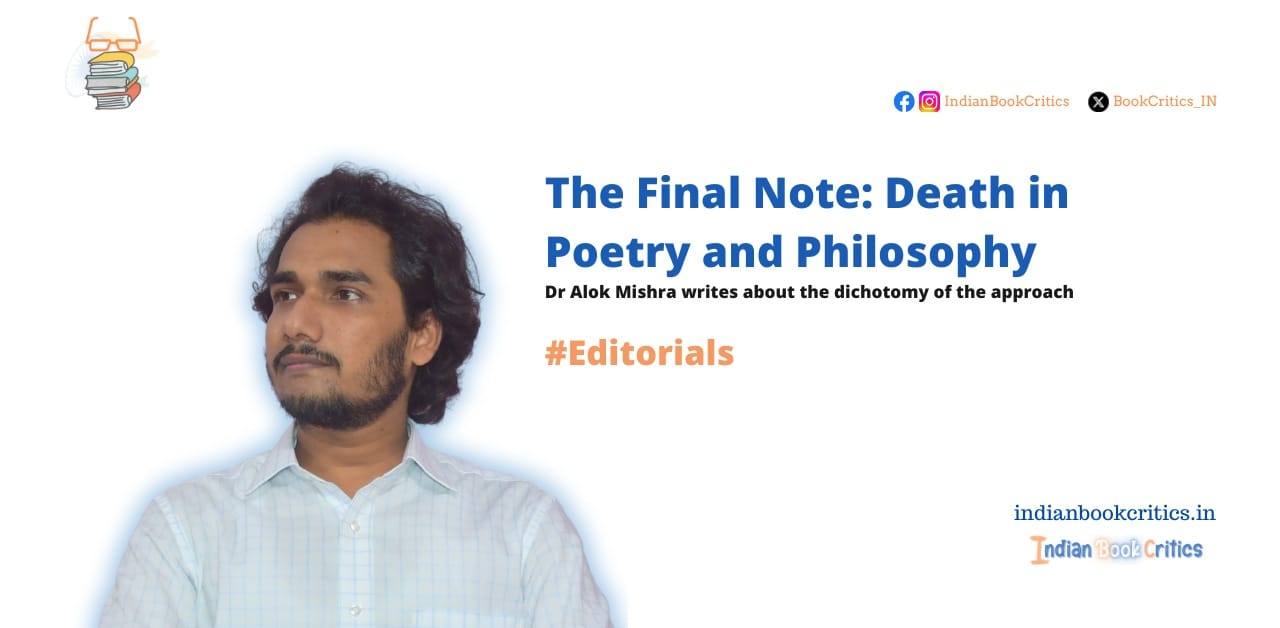
Once we accept death as the ultimate truth, all the lies become amusements for the sport we call life. This realisation, though seemingly bleak, liberates the human spirit from the obsession with continuity and permanence. It opens the consciousness to the profound understanding that all existence is a temporary theatre where performance matters more than duration. Death, therefore, is not an interruption but an inevitable punctuation, a full stop that gives meaning to the sentence of life. When poets meditate upon death, they do not merely lament its arrival but explore its necessity. When philosophers write about it, they often seek to rationalise it, to make peace with it through logic and metaphysics. In both realms, however, death stands as the grand equaliser—an inescapable truth that humbles kings and comforts slaves alike.
Death is the final note in the rhythm of life. Life is incomplete without it. Every living organism, every civilisation, and even every idea carries within itself the seed of its own demise. The poetic imagination finds immense beauty in this paradox. How something so feared, so final, can also be so necessary, so redemptive? Poetry celebrates death not as a void but as a presence, as an inevitable rhythm that allows life to find its structure. Without the finality of death, there can be no urgency in art, no sweetness in affection, no value in time.
Once we are receptive, every second in our lives plays like a melancholic tune to which we dance like possessed beings. Poets, more than anyone else, live within this awareness. Their words dance to the melancholy of impermanence. They inhabit the moment with heightened sensitivity, knowing well that each heartbeat is both an affirmation of life and a reminder of its frailty. The poet becomes the priest of mortality, performing the sacred act of turning grief into wisdom and transience into timelessness.
Poetry plays an immense role in making people accustomed to the idea of death as a natural outcome of life. Not only those who read poetry, but also those who witness extracts and random lines defining death not as an episode full of sorrow, but as a joyous culmination of a colourful drama, become the conscious messengers conveying this idea. Poetry, through the centuries, has helped humankind aestheticise death. From the ancient elegies of Greek poets to the bhakti verses of Indian saints, the poetic voice has taught generations to look at death not as a punishment but as a passage. John Donne’s meditation in “Death, be not proud” challenges the terror traditionally attached to it, proclaiming that death itself shall die. Emily Dickinson, with quiet transcendence, converses with death as a courteous companion rather than a tyrant. Shelley dreams of immortality through art, while Keats, dying young, finds solace in the permanence of his poetic voice.
Philosophical writings, while deliberating on the absurdity of life, complicate the idea of life by ascribing notions of liberation to death. The callous nature of para-worldly-dimensional philosophical and psychological non-fiction writings deprives ordinary human lives of the essential rainbows that comfort after the sweaty rains of excruciating labour, putting fire in the stoves of the world! Philosophy often treats death as a theoretical necessity, an abstract culmination of human reasoning about being and nothingness. From Plato’s dialogues on the immortality of the soul to Heidegger’s Being and Time, death remains an intellectual curiosity—something to be analysed, categorised, or transcended through thought. The philosopher, in his pursuit of ultimate truth, often forgets that the human heart cannot be consoled by abstraction. While philosophy might claim to liberate the mind, it frequently alienates the soul by denying the warmth of emotion that poetry sustains.
Philosophy eulogises death, perturbs lives. Poetry colours life and yet takes refuge in death, striking a harmonious balance! In other words, poetry interprets life, investigates various facets of it, and secretly courts death, wooing fancifully and willingly so that when the time comes, there is no fear. Philosophy, though married to mortality and the mundane life, remains ever unfaithful and flirts with death… and yet never fully understanding who she is, what she is, and what happens after she finally says yes.
The difference lies in approach. Poetry personalises death; philosophy intellectualises it. Poets create a dialogue with the end. They speak to death, not merely about it. They humanise it, give it a face, a voice, even a personality. In philosophical writings, death remains an abstraction—necessary, inevitable, but seldom intimate. The philosopher wishes to understand death, while the poet wishes to befriend it.
When we juxtapose the depiction of death in poetry and philosophical non-fiction, what emerges is the contrast between intuition and reasoning, between emotional acceptance and cerebral analysis. Poetry flows with the heart’s rhythm; philosophy moves by the mind’s logic. The poet’s encounter with death is spontaneous, while the philosopher’s engagement is constructed. Yet both share the same destination, albeit through different routes. The poet travels inward, descending into emotion; the philosopher ascends into abstraction. The poet finds meaning in mortality; the philosopher seeks meaning beyond it.
The fascination of poets with death arises not merely from fear or curiosity but from their acute sense of temporality. The poet knows that art, unlike life, can defy death. Every poem becomes an act of resurrection, a rebellion against decay. Through words, the poet creates a microcosm of eternity where thoughts, emotions, and voices live forever. This is why death, for the poet, is both muse and mirror. It inspires creation by reminding the creator of his limitations. The greater the consciousness of death, the deeper the urge to create something immortal.
While juxtaposing the depiction of death in poetry and philosophical non-fiction literature might be interesting, even more interesting is the rare successful intersection of philosophical quest and poetic expression, marked by the beauty of verse and the zeal of conveying. T. S. Eliot, Yeats, Dickinson, Wordsworth, Sri Aurobindo, Tagore, and Shakespeare, among other English writers, exhibit this rare blend when death emerges as the theme driving their poetry. Eliot’s The Waste Land merges existential philosophy with fragmented poetic imagery, making death both a metaphor and a reality. Yeats’s Sailing to Byzantium transforms mortality into an artistic transfiguration. Dickinson’s calm acceptance, Wordsworth’s serene submission, and Shakespeare’s dramatic confrontation with death illustrate the spectrum of poetic responses that turn philosophy into felt experience.
However, the best is revealed when we examine the ancient Sanskrit Hindu scriptures, especially the Upanishads. If we consider the Holy Gita as a work of philosophical poetry, the deliberation on life and death, side by side, by Sri Krishna, brings alive the liveliest version of life and the most liberating version of death, together on the same horizon. In the Bhagavad Gita, Krishna’s discourse transcends the dualities of existence. Death, he explains, is neither an end nor a tragedy. It is a transition, a continuation of the eternal cycle of becoming. The Gita does not mourn death; it celebrates the indestructibility of the soul. This synthesis of philosophy and poetry gives the text its immortality. The philosophical reasoning of Krishna is elevated by the lyrical cadence of his speech. The poetic rhythm carries the philosophical truth into the heart as much as into the mind.
Indian poetic traditions, from the Vedas to Tagore, have long treated death as a gateway rather than a grave. The Upanishadic question “What happens after death?” is not an expression of fear but of curiosity. The poet-sages did not dread death because they perceived it as the necessary dissolution of form, a return to the cosmic essence. In contrast, Western existentialists like Camus or Sartre grappled with death as the ultimate absurdity, a negation of meaning. Poetry, however, has always resisted this nihilism. It insists that meaning can be made, not merely found. Death in poetry is a paradox—while it signifies the end of being, it also affirms the continuity of consciousness through remembrance, art, and the legacy that remains.
Thus, poetry and philosophy both engage with death, but their dialectics differ. Philosophy aims to solve the mystery; poetry seeks to live it. The philosopher views death as a problem that demands intellectual resolution. The poet accepts it as an experience that completes existence. Where philosophy builds systems to contain the unknowable, poetry dissolves itself into the mystery, finding beauty in the act of surrender.
Death in poetry, therefore, is not an adversary but a companion. It travels beside the poet, whispering reminders of impermanence, urging creation, deepening awareness. In philosophy, death is the subject of debate; in poetry, it is a participant in dialogue. The former builds walls of abstraction; the latter opens windows of imagination.
Ultimately, both philosophy and poetry strive toward the same illumination: the acceptance of finitude and the discovery of eternity within it. Yet poetry triumphs in making this acceptance human. It does not strip death of its emotional reality but sanctifies it with understanding. It teaches us not to fear death, but to live with its awareness as the most honest way of living.
In the end, poetry and philosophy converge on the same realisation: once we accept death as the ultimate truth, all the lies become amusements for the sport we call life. Death, the final note in the rhythm of life, completes the melody, giving it depth, dignity, and meaning. The poet’s fascination with death is thus not a morbid obsession but a celebration of the finite that gestures toward the infinite. Through poetry, death is not merely understood; it is embraced, aestheticised, and transformed into art itself.
Dr Alok Mishra
Poet, Literary Critic, and Professor of English Literature