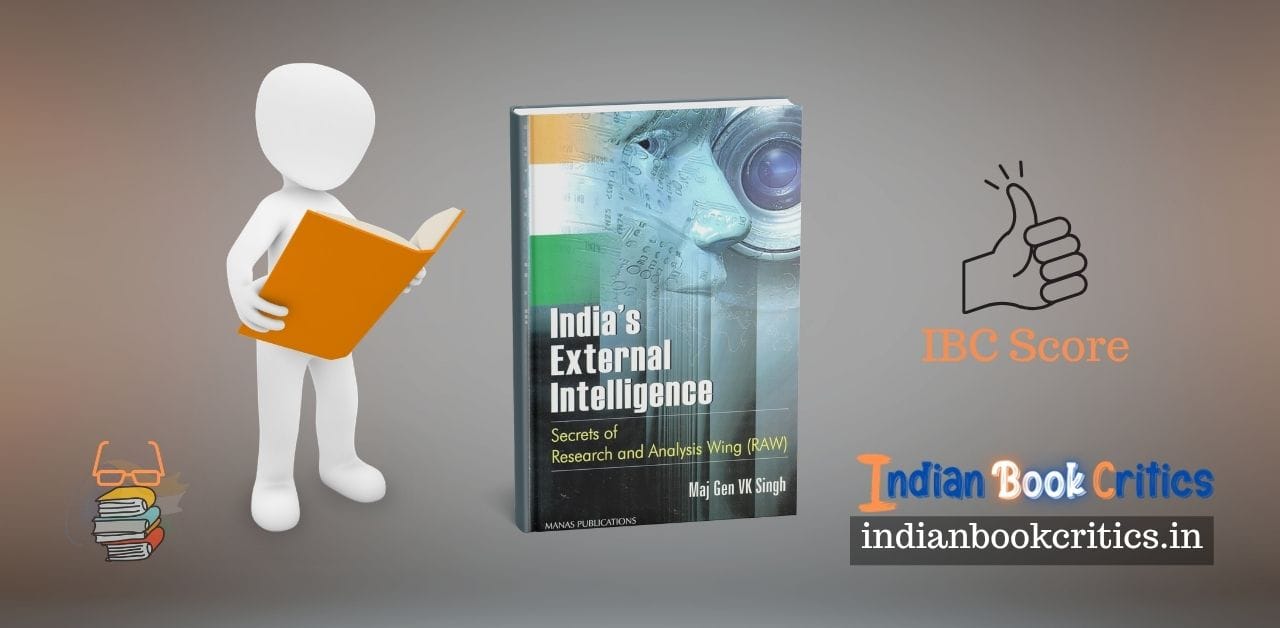
Some books attempt to describe intelligence agencies from the safe distance of speculation, journalistic reconstruction, and ideological assumption. Then there are books written by individuals who have inhabited the guarded interiors of these institutions and have witnessed their strengths, contradictions, and failures from within. Major General V. K. Singh’s India’s External Intelligence: Secrets of Research and Analysis Wing (RAW) belongs decisively to the latter category. The book is not merely an exposé of India’s external intelligence establishment, nor is it simply a memoir of an officer’s years within one of the country’s most secretive institutions. It is, rather, a layered and technically informed narrative that combines institutional history, bureaucratic critique, operational analysis, and personal observation into a remarkably engaging work of non-fiction. In a literary landscape where discussions of intelligence agencies are often overwhelmed either by sensationalism or patriotic simplification, Singh offers something more substantial: a sober, detailed, and technically grounded account of how intelligence systems function, how they falter, and how institutional weaknesses can become national vulnerabilities.
One of the most impressive aspects of the book is the author’s refusal to reduce RAW into a mythological construct. Public imagination frequently turns intelligence agencies into either omnipotent guardians or sinister conspiratorial organisations operating beyond democratic scrutiny. Singh avoids both extremes. Instead, he humanises the institution without romanticising it. The officers in these pages are not cinematic heroes but professionals navigating bureaucratic confusion, political pressures, procurement irregularities, inter-agency rivalries, and technological inadequacies. This realism gives the narrative unusual intellectual credibility. The author repeatedly demonstrates that intelligence work is less about glamour and more about systems, discipline, technology, secrecy, and institutional coordination.
The opening sections of the book are particularly effective in establishing this atmosphere. Singh’s transition “from soldier to spy” is narrated with a measured tone that neither exaggerates his importance nor diminishes the seriousness of the profession. His military background becomes an important interpretive lens throughout the work. Because he approaches intelligence through the discipline of a trained military officer, his observations possess a procedural clarity that distinguishes the book from many journalistic accounts of espionage. He is interested not only in what happened but also in how it happened, why systems failed, which technical loopholes existed, and how organisational inefficiencies created larger strategic consequences.
This technical precision is perhaps the book’s greatest strength. Many books on intelligence agencies lose momentum because the authors either become excessively anecdotal or burden the reader with inaccessible jargon. Singh maintains a careful balance. His explanations of signal intelligence, telecommunications monitoring, VSAT systems, and electronic surveillance mechanisms are detailed enough to satisfy serious readers while remaining intelligible to non-specialists. The chapters dealing with the Telecom Division and signals intelligence stand out in this regard. Instead of presenting technology as an abstract instrument, Singh shows how intelligence infrastructure depends on procurement policies, technical competence, equipment reliability, and institutional accountability.
The chapter concerning the VHF/UHF antenna case is especially revealing because it exposes how technical manipulation and bureaucratic corruption intersect within sensitive national security frameworks. Singh carefully reconstructs how specifications were altered and how procurement processes became susceptible to manipulation. What makes this section compelling is not merely the allegation of irregularity but the methodical manner in which the author explains the technical dimensions behind the controversy. Lesser writers might have reduced such episodes into rhetorical outrage. Singh instead demonstrates how even minor deviations in technical evaluation can produce severe strategic implications. His argument gains force precisely because it emerges from procedural detail rather than emotional accusation.
Similarly, the discussion surrounding the VSAT project illustrates the author’s capacity to connect technological systems with national vulnerability. Singh repeatedly emphasises that dependence on foreign technologies in intelligence infrastructure carries serious risks. He does not present this argument through abstract nationalism. Instead, he analyses the issue through operational logic. Foreign-manufactured equipment, external technical dependencies, and compromised procurement mechanisms can create security exposures that remain invisible until a crisis occurs. The seriousness of the argument lies in its practicality. Singh understands that intelligence failures are often born not in dramatic moments of betrayal but in neglected technical processes, ignored warnings, and complacent administration.
The narrative acquires even greater emotional force in chapters such as “For a Few Pieces of Silver” and “The Death of Vipin Handa.” Here the book transcends institutional critique and enters the territory of moral reflection. Singh writes with restraint, and it is precisely this restraint that gives these sections their power. He does not sensationalise tragedy. Rather, he allows facts, procedural lapses, and bureaucratic insensitivity to reveal the deeper ethical crisis within the system. The account of Vipin Handa’s death is especially moving because the author recognises the human cost hidden behind intelligence operations. Officers working within covert systems frequently disappear into anonymity, and their personal sacrifices rarely receive public acknowledgement. Singh restores a measure of dignity to these forgotten figures.
Another major contribution of the book lies in its treatment of inter-agency rivalry, particularly the strained relationship between RAW and the Intelligence Bureau. Singh avoids simplistic blame games. He instead analyses how institutional competition, overlapping jurisdictions, ego clashes, and fragmented coordination weaken national security architecture. The significance of this analysis cannot be overstated. In intelligence work, information loses value when agencies fail to cooperate effectively. Singh repeatedly shows that bureaucratic fragmentation can become as dangerous as external threats themselves.
His treatment of the Rabinder Singh episode is equally noteworthy. This section could easily have descended into sensational spy-thriller territory, but Singh’s disciplined prose prevents such a collapse. He examines the case not merely as an individual betrayal but as evidence of structural weaknesses in counter-intelligence mechanisms. The author’s focus remains institutional rather than melodramatic. He is less interested in constructing villains than in understanding how systems become vulnerable to penetration. This analytical seriousness distinguishes the book from popular espionage literature.
The prose style deserves special appreciation because it reflects the author’s intellectual temperament. Singh writes in a direct, unornamented, and disciplined manner. His language is free from unnecessary rhetorical flourishes, yet it never becomes dry. There is a measured authority in his narration that comes from lived experience rather than literary performance. One notices throughout the book that the author respects the intelligence of the reader. He does not simplify complex matters into slogans, nor does he indulge in self-glorification. The writing possesses a documentary quality that strengthens its credibility.
At the same time, the prose is not emotionally sterile. Beneath the technical discussions and procedural analyses runs a persistent current of disappointment and concern. Singh clearly believes that intelligence agencies occupy a critical position within national security structures and therefore must operate with professionalism, accountability, and integrity. His criticisms emerge from institutional commitment rather than cynicism. This distinction is important. Many exposés are driven by bitterness; Singh’s critique is driven by concern for systemic improvement.
The structural design of the book also deserves attention. The progression from personal initiation into RAW, to institutional history, to technical operations, and finally to larger questions of accountability creates a coherent narrative movement. Each chapter contributes to a cumulative understanding of the agency. Even when the book shifts into highly technical territory, the author ensures that the broader institutional context remains visible. As a result, readers do not experience the text as a disconnected collection of incidents but as an integrated examination of India’s intelligence framework.
An especially admirable feature of the work is the author’s understanding of secrecy itself. Intelligence agencies necessarily depend on secrecy, but Singh repeatedly suggests that secrecy without accountability becomes dangerous. This is perhaps the central philosophical tension running through the book. Democratic states require intelligence organisations capable of operating covertly, yet these same organisations must remain subject to institutional oversight. Singh does not advocate reckless transparency. He understands operational necessities. However, he argues persuasively that complete insulation from scrutiny breeds inefficiency, corruption, and strategic complacency.
The book’s relevance becomes even greater when considered within the broader global discourse surrounding intelligence systems after the Cold War and especially after the rise of transnational terrorism. Nations across the world have struggled to balance security imperatives with democratic accountability. In this context, Singh’s work emerges as an important Indian contribution to conversations usually dominated by Western intelligence narratives involving the CIA, MI6, Mossad, or the KGB. One of the book’s achievements is that it situates RAW within a recognisably international framework while still addressing specifically Indian institutional realities.
You can get a copy of this book from Amazon India – click here to buy one.
Thanks for reading this detailed review.
Happy Reading!
Madhav for Indian Book Critics