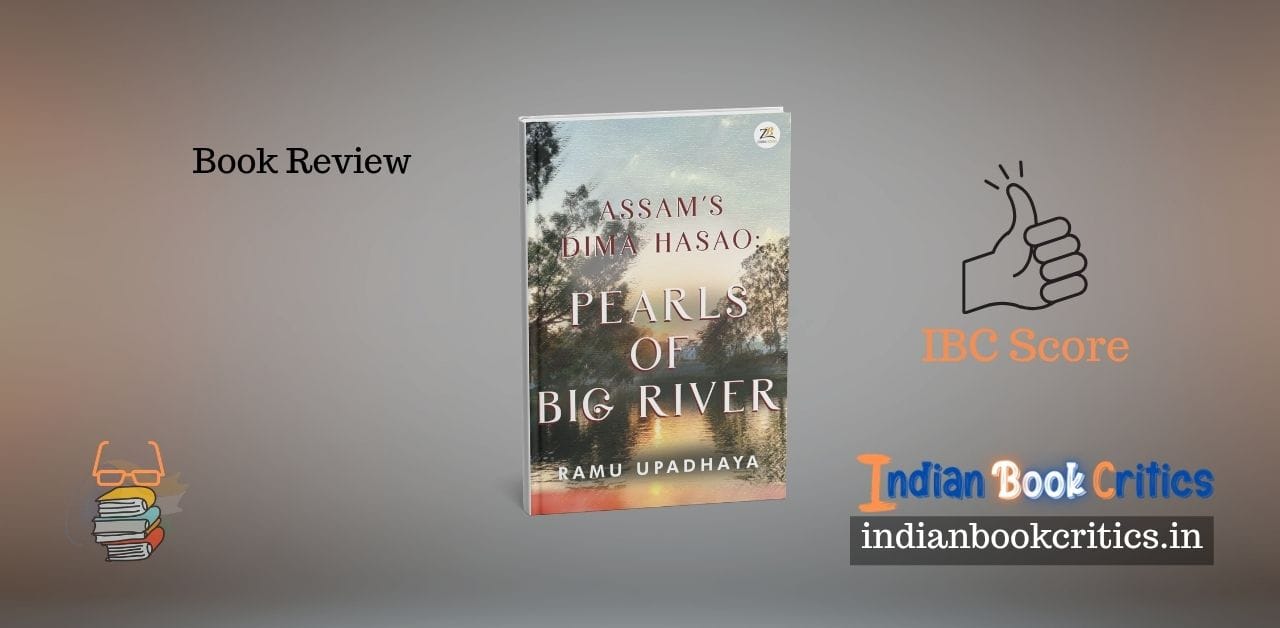
Some books tell us about places, and there are books that invite us to live inside them. Ramu Upadhaya’s Pearls of Big River: Assam’s Dima Hasao belongs firmly to the latter category. At first glance, the book appears to be a collection of biographies documenting the lives of eminent personalities from Dima Hasao, Assam’s only hill district. However, as one moves through its pages, it becomes clear that this is much more than a regional history. It is a memoir, a historical archive, a cultural document, a political reflection, and above all, a deeply personal act of remembrance.
What makes the book distinctive is not merely the wealth of information it contains but the emotional urgency that drives it. Upadhaya writes as someone who has watched his homeland transform across decades. His concern is not simply to narrate history but to rescue it from neglect. Throughout the book, one senses an author anxious that the contributions of ordinary visionaries and extraordinary citizens might disappear beneath the weight of shifting political narratives and collective forgetfulness.
The opening pages immediately establish this deeply personal connection. In the preface, significantly titled Whisper of Heart, Upadhaya reflects:
“I feel fortunate to have been born into a beautiful place where some idealists and humanists… went into oblivion.”
That single sentence captures the spirit of the entire book. This is less an exercise in academic historiography than an attempt to restore memory to those who deserve it.
More Than a Regional History
One of the book’s greatest strengths is its refusal to confine itself to a single genre. While readers may initially expect a straightforward historical account of Dima Hasao, they instead encounter a narrative that constantly shifts between autobiography, biography, social commentary, political reflection, environmental concern, and developmental vision.
The opening chapters immerse readers in Upadhaya’s childhood memories of Bhanjang and Haflong. These recollections are not merely nostalgic diversions. They provide the emotional foundation upon which the later historical narratives are constructed. The streets, schools, neighbours, teachers, and childhood adventures become symbols of a community that shaped the personalities later celebrated throughout the volume.
This movement from the personal to the collective gives the book an unusual warmth. The historical figures introduced later do not appear as distant statues of greatness but as people connected to the same landscape the author remembers so vividly.
Celebrating Unsung Builders of Society
The heart of Pearls of Big River lies in its remarkable gallery of personalities. However, there is a subtle difference that marks a visible shift in the approach to painting in this gallery. Instead of focusing exclusively on nationally celebrated figures, Upadhaya turns his attention towards regional leaders whose contributions transformed Dima Hasao’s educational, political, and social institutions. Leaders such as Joy Bhadra Hagjer, Surath Chandra Daulagupu, Sonaram Thaosen, Gobinda Chandra Langthasa, and many others emerge not as mythical heroes but as individuals whose dedication gradually shaped the district’s identity.
The author also deserves appreciation for widening his definition of leadership. Politicians are certainly present, but so are teachers, administrators, social reformers, women pioneers, cultural workers, and community builders.
Particularly refreshing is the chapter dedicated to women, appropriately titled The Strong-Minded Gender. Figures such as Pramila Hojai and Nirupama Hagjer are not presented merely as symbolic representatives but as individuals whose achievements challenged conventional limitations and broadened opportunities for future generations.
Similarly, Ramu Upadhaya’s inclusion of contributors from diverse ethnic communities reflects one of the book’s central convictions: history belongs to everyone.
The Celebration of Diversity
Perhaps the book’s most compelling intellectual contribution lies in its understanding of Dima Hasao as a living example of multicultural coexistence.
Throughout the narrative, Upadhaya repeatedly emphasises that the district has never belonged exclusively to one community. Instead, he celebrates it as a shared homeland where Dimasa, Hmar, Karbi, Bengali, Gorkha, Kuki, Zeme Naga, Hrangkhol and several other communities have collectively shaped its identity.
In today’s increasingly polarised social atmosphere, this emphasis on pluralism feels particularly meaningful.
Rather than reducing identity to ethnic boundaries, the author repeatedly argues that shared institutions, educational progress, and mutual respect have historically sustained the district.
The argument never feels forced because it emerges naturally through the biographies themselves. The lives documented in the book collectively demonstrate how cooperation, rather than competition, built modern Dima Hasao.
Nature as a Living Character
One of the quieter pleasures of reading Pearls of Big River is discovering how intimately the author knows the landscape he describes. The rivers, forests, hills, lakes, valleys, and villages are not treated as decorative scenery. They become active participants in the narrative. Haflong, Jatinga, Mahur, the Diung River, and the surrounding hills appear repeatedly, almost assuming the role of recurring characters.
The author’s affection for these places is unmistakable. Yet this affection is accompanied by genuine anxiety. He repeatedly warns against reckless urbanisation, environmental degradation, and developmental policies that ignore the fragile ecology of the region. His concerns regarding landslides, deforestation, and poorly planned infrastructure projects transform the book into something more than historical documentation. It also becomes an environmental appeal.
Without sounding alarmist, Upadhaya asks readers to consider an uncomfortable possibility: what happens if development destroys the very landscape that defines Dima Hasao?
Education as the Foundation of Progress
If one idea binds together almost every chapter, it is the transformative power of education.
Again and again, the book returns to schools, teachers, colleges, scholarships, and educational institutions. Upadhaya portrays education not merely as personal advancement but as collective emancipation. Stories of pioneers establishing schools under difficult circumstances become some of the book’s most inspiring passages. These narratives remind readers that educational institutions rarely emerge automatically. They are often built through the persistence of individuals who understand that literacy ultimately reshapes society.
The emphasis never becomes repetitive because each biography approaches education from a different perspective, illustrating its role in leadership, social mobility, and public service.
A Writer Guided by Conviction
Stylistically, Ramu Upadhaya occupies an unusual literary space.
His prose frequently moves between lyrical reminiscence and administrative precision. One page may contain affectionate childhood memories, while the next discusses constitutional provisions, recruitment policies, municipal governance, or infrastructure planning.
For readers expecting a conventional literary narrative, these transitions can initially seem abrupt. Yet gradually one begins to recognise that this structural unevenness reflects the author’s personality. He is simultaneously a memoirist, historian, citizen, administrator, and social thinker. Rather than compartmentalising these identities, he allows them to coexist naturally within the same work.
The result is a book that occasionally sacrifices narrative smoothness but gains authenticity.
His language often carries a moral earnestness that feels refreshingly sincere. Consider his unusual dedication:
“…I dedicate the narrative to all evils… with my good works to defeat.”
It is an unconventional statement, perhaps even surprising, but it reveals an author unwilling to disguise his ethical commitments beneath detached neutrality.
Throughout the book, Upadhaya writes not as an observer standing outside history but as someone deeply invested in its future.
Where the Book Falters
Despite its many strengths, Pearls of Big River is not without shortcomings. The most noticeable limitation is structural consistency. The narrative occasionally shifts too suddenly between personal recollections, lengthy biographies, policy recommendations, philosophical reflections, and developmental proposals. These transitions can interrupt the reading experience, particularly for readers unfamiliar with the region.
Similarly, the book would have benefited from stronger editorial refinement. Some chapters contain long, densely packed sentences that occasionally obscure otherwise valuable insights. The language sometimes becomes overly formal, and certain passages repeat similar ideas about morality, governance, and public service. A more rigorous editorial intervention might have improved the pacing without diminishing the author’s voice.
Another aspect that may divide readers is the author’s openly evaluative tone. Ramu Upadhaya frequently contrasts the idealism of earlier generations with what he views as the ethical decline of contemporary politics. While many readers may sympathise with these concerns, others might wish for greater analytical distance or engagement with alternative viewpoints.
Nevertheless, these limitations never significantly undermine the book’s larger achievement. These limitations are purely academic, subjective and personal observations. The achievement of the author and the book, and the collective literary value that the book and its author achieve, are appreciable.
An Archive with a Human Face
Perhaps what impressed me most while reading Pearls of Big River was its refusal to reduce history to statistics or official records. Every biography carries emotional texture. Every institution is connected to individuals who struggled to establish it. Every village possesses memories. Every landscape holds stories. The book repeatedly reminds us that regional history survives not only through government archives but through people willing to remember. That willingness gives the book its emotional power.
Final Verdict
Pearls of Big River: Assam’s Dima Hasao is not a polished literary masterpiece in the conventional sense, nor does it aspire to be one. Instead, it succeeds in something arguably more valuable. It preserves the collective memory of a region whose stories rarely occupy national conversations.
Ramu Upadhaya writes with affection, conviction, and unmistakable sincerity. His admiration for Dima Hasao never descends into empty romanticism because it is balanced by genuine concern for its environmental future, educational progress, and social harmony.
Readers looking for a tightly structured academic history may occasionally find the narrative diffuse. Those expecting a conventional memoir may be surprised by its political reflections. Yet readers willing to embrace the book on its own terms will discover a rich tapestry woven from memory, biography, landscape, ethics, and hope.
Ultimately, Pearls of Big River is not simply about remarkable individuals. It is about the values they represented: integrity, public service, educational commitment, communal harmony, and an abiding love for one’s homeland.
In preserving those values alongside the lives that embodied them, Ramu Upadhaya has produced something that transcends regional documentation. He has created a literary monument to a community, reminding readers that history is not merely what happened, but what a people choose to remember.
Get a copy of the book from Amazon India – click here.
Review by Dr Alok Mishra
(Poet, Book Critic, and a Professor of English Literature at Nava Nalanda Mahavihara)