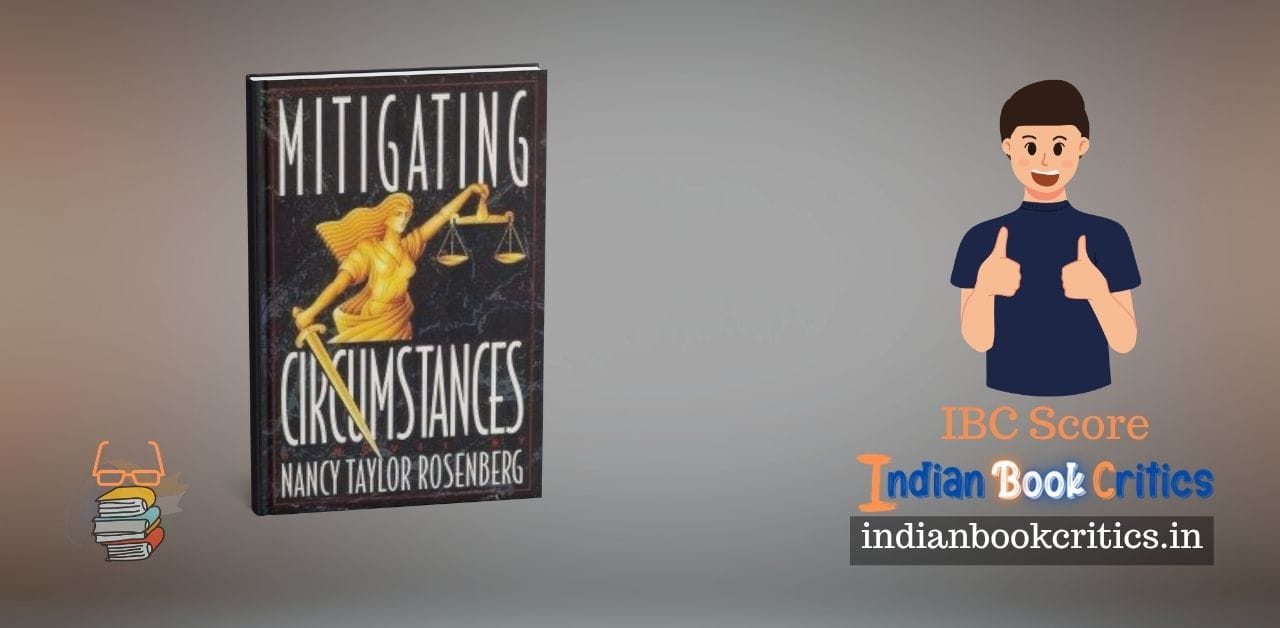
Justice may be blind, but Nancy Taylor Rosenberg reminds us that those who serve it are not. And not in one or two works by her; she does it in most of her works… And today, I am discussing her famous novel Mitigating Circumstances.
When readers discuss the great legal thrillers that emerged during the remarkable publishing boom of the late 1980s and the 1990s, a handful of names invariably dominate the conversation. John Grisham transformed courtroom drama into commercial entertainment with The Firm and The Pelican Brief. Scott Turow elevated the genre with literary sophistication in Presumed Innocent. Richard North Patterson infused legal fiction with political and ethical complexity, while Patricia Cornwell expanded crime fiction through forensic realism. Somewhere amid these celebrated names stands Nancy Taylor Rosenberg, an author who enjoyed enormous commercial success during the period but whose reputation has faded far more than her writing deserves. Mitigating Circumstances, originally published in 1993, was not only her breakthrough novel but also one of the books that demonstrated how legal thrillers could be as emotionally compelling as they were procedurally authentic. The novel introduces Assistant District Attorney Lily Forrester in a courtroom where a seemingly routine sentencing hearing immediately establishes the central conflict between law and justice, and where the absence of “mitigating circumstances” becomes both a legal phrase and a philosophical question that echoes throughout the novel. Even after more than three decades, the novel remains remarkably engaging, although it also reveals certain characteristics that firmly anchor it in the literary sensibilities of its era.
One of the first things that distinguishes Mitigating Circumstances from many legal thrillers of its generation is that Nancy Taylor Rosenberg writes from experience rather than observation. Before turning to fiction, she spent years working in law enforcement and court investigation, and that professional background permeates every chapter. Readers never feel that the legal proceedings exist merely to create suspense. Courtrooms are not theatrical arenas where lawyers deliver impossible speeches that magically change verdicts. Instead, they are bureaucratic institutions inhabited by exhausted prosecutors, frustrated detectives, overworked judges and emotionally drained investigators. Lily Forrester herself is introduced not as a glamorous legal genius but as a woman worn down by years of prosecuting violent criminals, deeply disturbed by a justice system that repeatedly releases dangerous offenders back into society. Her anger after witnessing another lenient sentence and her growing disillusionment with the criminal justice system establish the psychological foundation upon which the entire narrative rests. Rosenberg’s familiarity with these institutions lends the novel a credibility that many contemporary legal thrillers strive for but rarely achieve. The offices, courtrooms, police stations and informal conversations between prosecutors feel lived-in rather than researched.
Lily Forrester is, without question, the novel’s greatest achievement. In an era when female protagonists in commercial thrillers were still relatively uncommon, Rosenberg creates a woman whose professional competence never overshadows her emotional complexity. Lily is ambitious, fiercely intelligent and uncompromising in court. Yet she is simultaneously struggling with a collapsing marriage, a distant teenage daughter, loneliness and a persistent feeling that professional success has come at an immense personal cost. Rosenberg refuses to simplify her protagonist into either a feminist icon or a tragic victim. Lily is flawed. She can be impatient, judgmental and emotionally impulsive. She often allows professional frustrations to influence her personal relationships, while her desire for control sometimes borders on obsession. Yet these imperfections make her extraordinarily believable. Her reflections on her neglected birthday, her strained family life and her longing for recognition transform her into far more than a prosecutor pursuing criminals. Compared with many protagonists created by John Grisham during the same period, Lily possesses considerably greater psychological depth. Grisham’s heroes frequently function as reluctant participants in institutional conspiracies. Lily, by contrast, is herself a part of the institution, constantly questioning whether that institution deserves her loyalty.
The novel’s greatest thematic strength lies in its exploration of justice rather than legality. Rosenberg repeatedly asks whether legal verdicts necessarily produce moral justice. The title itself becomes increasingly significant as the narrative progresses. Courts routinely search for mitigating circumstances to explain criminal behaviour, but Rosenberg extends the concept far beyond legal doctrine. Are there mitigating circumstances behind personal failure? Can professional responsibility excuse emotional neglect? Does trauma justify revenge? These questions are never answered simplistically. Instead, they accumulate gradually as the plot unfolds, forcing readers to examine their own assumptions about punishment, forgiveness and responsibility. Unlike many thrillers that celebrate the final courtroom victory as the ultimate resolution, Mitigating Circumstances recognises that verdicts rarely heal emotional wounds. Crimes end; consequences continue. This moral ambiguity elevates the novel above conventional courtroom entertainment.
Another admirable quality is Rosenberg’s ability to integrate domestic life into legal fiction without reducing either dimension. Lily’s professional responsibilities constantly intersect with her personal life. Her deteriorating marriage is not merely a subplot inserted to humanise the protagonist. Instead, it mirrors the emotional exhaustion generated by years of confronting violence and human cruelty. The scenes involving her husband John and daughter Shana reveal the invisible cost of working within the criminal justice system. Prosecutors are expected to fight for victims during the day while somehow returning home as emotionally available spouses and parents in the evening. Rosenberg demonstrates how impossible that expectation often becomes. Long before contemporary discussions about burnout, secondary trauma and mental health among legal professionals became widespread, she had already begun exploring those realities through fiction.
Rosenberg’s narrative style deserves equal appreciation. Her prose is not particularly lyrical, nor does it aspire to literary ornamentation. Instead, it is economical, disciplined and relentlessly functional. Every chapter advances either character or conflict. Dialogue drives the narrative with remarkable efficiency, particularly the exchanges between prosecutors, investigators and judges. These conversations possess an authenticity born of experience rather than invention. Unlike Scott Turow, whose novels often pause for lengthy philosophical reflections, Rosenberg prefers movement. The result is a novel that remains consistently readable without sacrificing thematic seriousness. Suspense arises not merely from discovering who committed a crime but from wondering how ordinary people will respond when their moral certainties begin collapsing around them.
Yet Mitigating Circumstances is not without limitations, and acknowledging them only strengthens one’s appreciation of the novel as a whole. Readers approaching it from a twenty-first-century perspective will immediately notice certain narrative conventions that reflect the commercial thriller tradition of the early 1990s. Some secondary characters are drawn rather broadly, occasionally functioning more as representatives of institutional attitudes than as fully realised individuals. The romantic tension surrounding Lily occasionally relies upon familiar genre expectations that modern readers may find somewhat predictable. At times, Rosenberg also favours melodramatic emotional confrontations where greater restraint might have produced stronger psychological impact. The pacing, although generally effective, occasionally slows because of repetitive descriptions of workplace interactions or procedural conversations whose narrative function has already been established. These shortcomings never undermine the novel, but they do prevent it from reaching the literary sophistication of Scott Turow’s finest work.
Another aspect that may divide readers is Rosenberg’s uncompromising portrayal of violent crime. She neither sensationalises brutality nor softens its consequences. Violence in this novel is disturbing because it feels plausible. Criminals are rarely transformed into charismatic anti-heroes, and victims are never reduced to convenient plot devices. However, the emotional intensity generated by this realism occasionally produces a relentlessly sombre atmosphere. Readers expecting the lighter entertainment offered by many contemporary legal thrillers may find Rosenberg’s world emotionally demanding. She offers very little comic relief, and moments of optimism are usually brief before another ethical or emotional crisis emerges. Nevertheless, this tonal consistency ultimately reinforces the novel’s central concern: the pursuit of justice is exhausting precisely because human suffering is inexhaustible.
From a historical perspective, Mitigating Circumstances occupies an important place in the evolution of legal fiction. During the early 1990s, courtroom thrillers were becoming increasingly formulaic. Many relied upon spectacular conspiracies, corrupt corporations or implausible legal twists designed primarily for commercial excitement. Rosenberg chose a different path. She remained interested in ordinary prosecutors, institutional limitations and the psychological burdens carried by those responsible for administering justice. In many respects, her work anticipated later crime writers who would place greater emphasis on emotional realism rather than procedural spectacle. One can even detect elements that would later become common in the novels of Lisa Scottoline, whose female legal protagonists similarly balance professional competence with personal vulnerability. Yet Rosenberg’s voice remains distinctly her own because it emerges from practical experience rather than literary imitation.
It is perhaps surprising that Nancy Taylor Rosenberg is discussed far less frequently today than many of her contemporaries. The reasons have less to do with literary quality than with changing publishing trends. John Grisham continued producing blockbuster after blockbuster, Michael Connelly built an enduring detective franchise, while Patricia Cornwell transformed forensic fiction into a global phenomenon. Rosenberg, despite writing several bestselling novels, gradually disappeared from the centre of popular literary conversation. Revisiting Mitigating Circumstances reveals how undeserved that relative neglect has been. The novel possesses an authenticity, emotional maturity and moral seriousness that allow it to age far more gracefully than many thrillers that once outsold it. Even its dated elements now function as historical markers, offering readers a fascinating glimpse into American legal institutions and social attitudes during the early 1990s.
Ultimately, Mitigating Circumstances succeeds because it never forgets that behind every legal case stands a damaged human life. Nancy Taylor Rosenberg refuses to romanticise either crime or justice. She understands that courtrooms cannot repair every wound, that legal victories often coexist with personal defeats, and that those entrusted with protecting society frequently sacrifice their own emotional well-being in the process. Lily Forrester remains one of the most compelling female protagonists in legal fiction because she embodies these contradictions with remarkable honesty. The novel may occasionally reveal the conventions of its time, and its structure is not entirely free from predictable turns. Yet its emotional authenticity and institutional realism continue to command respect. More than thirty years after its publication, Mitigating Circumstances deserves to be remembered not merely as a bestselling legal thriller but as a thoughtful exploration of justice, responsibility and the hidden costs of serving the law. For readers interested in legal fiction that values moral complexity over courtroom spectacle, Nancy Taylor Rosenberg’s debut remains an immensely rewarding discovery.
Review by Gunjan for Indian Book Critics
Mitigating Circumstances by Nancy Taylor Rosenberg – Review
- IBC Critical Rating
Summary
A prolonged, entertaining, and evergreen legal thriller classic… ideal for those who value quiet and patient reading.